19. Queuing like you really mean it.

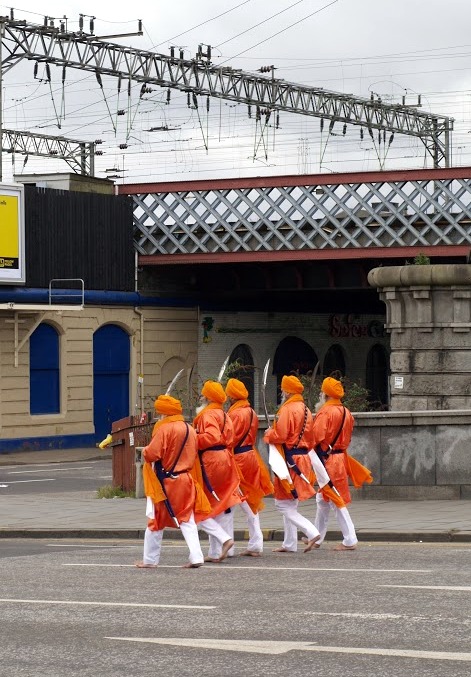
ImageYork’s new rapid transit system.

After the weather forecast comes the Pollen forecast. For some reason I expect to see it presented by a giant bee, in bee language.

Its pretty difficult to get a GP appointment nowadays, certainly for hay fever. I read in The Times that some GPs are averaging 66 consultations per day. If so, the situation is crying out for a production line system like they use in car factories, where patients move slowly along a conveyor belt in a giant shed.

In fact I see no reason why hospitals shouldn’t operate like this, making so called ‘care pathways’ something of a reality. There would be a faster track through the A and E department, in the same way as East Coast trains fly past First Capital Connect at Potters Bar.

If we have a track for Depression though, lets not make it a tunnel.

Recently I made a GP appointment – I couldn’t really say it was urgently needed, since, like most doctors in fact, I am a bit of a hypochondriac.

Also I made the big mistake of saying ‘its probably nothing’ to the receptionist.

I got an appointment more than 3 weeks later. Of course, like most self-limiting conditions, which is most conditions, it had already got better by the time I got to see the GP. I went in with a grovelling apology and came out in less than a minute. I felt I had blown a bit of credibility though, in case I get a genuine illness one day. Several Cry Wolf points thrown away.

Perhaps there should be a special ‘disloyalty card’ where persistently not attending earns you extra points. Every now and again these could be traded for a free consultation without prejudice.

This set me wondering whether anyone knows how to use the health care system properly. And if so, how can we learn how to do it?

After all, most illness behaviour is determined by social learning.  But no-one ever properly teaches us how to ‘do healthcare’.

We all have a huge stake in the NHS, but, amazingly, the NHS comes with no instruction manual.

Its the kind of thing Michael Gove definitely hasn’t put on the schools’ national curriculum, revealed today. But should he?

At the end of every human interest piece on the news, such as spontaneous combustion in sheep, the damage done by carrier bags or how yogurt can become dangerous under certain circumstances, the answer is always a call for ‘better education’.

This must be hugely irritating to teachers, whose curriculum is already big enough and struggling to cope with constant tinkering.

But along  these lines, instead of say, History, or Geography, why not some basic Medical Sociology?

We could learn about the pernicious effects of the private sector, the inverse care law that affects poor people, how health care systems struggle to constrain costs and how it took the French Revolution to smash the four humour system.

We could learn the difference between Disease, Illness and Sickness, and how the sick-man has disappeared from Medical Cosmology*. Perhaps he will turn up in the cafeteria or X Ray.

We could learn about the sick role and how to play it. We could have a field trip to the Broad Street Pump, where Snow discovered how cholera got transmitted.

Maybe answer the question, why isn’t holistic spelled ‘wholistic’?

We could look at screening programs and learn – very quickly – which ones are worthwhile. Borrowing a few sessions from Science we could look at Causation versus Association and show improving movies like Moneyball. (Subtitle: the art of winning an unfair game.)

If that’s not better than learning the details of World War One peace treaties, I don’t know what is.

We seem to have an insoluble problem in the UK. It is free to go the doctor or see a specialist. Although if we need to get medication it costs £7.85 per item, plus 90p to park. If it involves driving into Nottingham then there’s a £30 charge for getting in the tram lane by accident, and by accident I mean by being careless.

If we try and impose any charge, it looks as though we will discourage the very people who need to see the doctor most often, and the people who most need to drive over tramways. A number of famous studies suggest the most deprived people are those who have the highest rates of illness and shortest life spans.

But being free, the NHS system seems to attract a large number of people whom car dealers would call tyre – kickers.

Perhaps the fairest and most effective way to ration health care would be to create a giant lottery for appointments, or to make them transferable, so that slots could be traded on the open market.

In the GP waiting room, as I cowered in my corner, peering over a 1998 edition of Auto Express magazine, it looked as though the other aspiring patients needed a bit of weeding out, or triage, as it’s called in health care.

With images of Taksim Square in mind, I imagined a military type person coming out with a loud hailer every few minutes:

Anyone whose temperature is 37 or less, please leave.

Anyone with a bad cold or flu, out!.

Anyone with backache, headache, neckache, tennis elbow, golfers’ elbow, or any other kind of elbow – out!.

Anyone with a twinge.

Anyone with insomnia.

Anyone with indigestion.

Out, out, out!

Anyone here for a screening test not based on sound epidemiological evidence?

(Pauses for a moment) It’s 95% certain you should leave.

Now we are seeing a definite thinning in the crowd and a line of people heading for the Cooperative Pharmacy or the alternative practitioners ghetto. No need for the water cannon and rubber bullets after all.

The military style triage is unlikely to prove acceptable in the era of consumerism. Tesco don’t use it, even for the people who turn up at 9pm to get the reduced loaves and then ride around the car park in trolleys.

Instead we have had NHS Direct and 111 – who tend to ‘direct’ you to A and E.

The A and E department have their own filtering system, using time and, to a lesser extent, squalor. More recently they have taken a lead from Heathrow and created a stacking system for ambulances, which circle the hospital, waiting for a landing slot.

I made the mistake of trying to reach Leicester Royal Infirmary by car recently. Like the health care system in microcosm, there is no way in and no way out. I felt like an Apollo space capsule, orbiting the moon, but I had no lunar module to send down.

Those with self limiting conditions have probably got better by the time they are seen. Even those people who are seeking healthcare mainly to meet other people who are seeking healthcare and chat to them, have had enough social contact after 3 hours in a hot little waiting area with a very expensive Coke machine and a silent, armoured television showing volleyball from Belgrade.

Using time as a subtle disincentive is an example of the ‘British’ way of filtering access to healthcare, which is called ‘implicit’ or ‘covert’ rationing. For example, many people who are referred to primary care mental health or substance misuse services receive a letter asking the prospective patient to ring up and make an appointment. Sometimes this also involves filling in some forms and rating scales. A really off-putting one is asking an open question like, ‘what would you say are the aims of this appointment?’

This little change in the Choice Architecture reduces the number of people given appointments significantly. Perhaps these not-very-motivated patients are the right ones to weed out. Or perhaps not. Maybe those who are least forthcoming are most in need.

Because mental health services are very limited, and mental health problems are very common, there is a massive amount of covert rationing for psychological treatments.  Which brings us to the pressing issue. If it’s that difficult to get an appointment for something concrete and medical, like muscle cramps and twitching, oops I gave it away, how much more difficult must it be for a depressed person to enter the system?

Most people with Depression have reduced energy and motivation. Often they are ashamed of seeming weak or useless. Studies have shown that it takes most people a long time to get round to making an appointment. Often it takes a crisis of some kind to bring people into contact with services.

Recently I’ve seen people turned away from blood-doning sessions because they had not made an appointment, even O negative donors, like myself, who should be given the red carpet and chocolate digestives.

I heard would- be donors say things like, ‘I just like to come down here when I’m able to, I just can’t plan that far ahead’. The person in charge assured them that the new appointments system was much more efficient.The Times (10.06.13) reports that the number of blood donors has fallen by 23% in the last ten years.

NHS blood and transport are apparently looking to attract young donors, so perhaps this should also be included in the national curriculum. I’d have given more blood if doning had been offered as an alternative to PE.

It would perhaps make sense to abandon or reduce the system of making appointments in favour of just turning up. We seem to like walk in centres and A and E, where we go when we need to.

In fact I seem to remember GP surgeries used to be like this, before appointments took over. I am sure GPs can produce evidence supporting the idea of appointment systems. And further evidence to support their recent system of the mad telephone rush for slots, jamming the  lines at 8.30 am.

But there has been a massive change recently in the number of things you can do while you wait. This has transformed public transport and it could transform access to healthcare.

If you have a tablet computer, or smart-phone even, you can listen to music, read a book or two, watch a movie and play a few games.

You can skype your relatives and buy a new cardigan online.

This is quite different from even 10 years ago, when you had to be content with old copies of Golf Monthly, collections of curling pucks and a fish tank.

Somehow we have created a system where people’s time is felt to be incredibly important and they can’t be released from work. Did planners fondly imagine that people would pop out of work during their lunch break to have a quick endoscopy?

It looks as though ill people will seek help, providing they know which queue to join and where it starts. All they need is a sign saying, ‘Stagger this Way’.

The biggest crime in the NHS is to make covert rationing ‘explicit’. It’s a bit like a magician showing how the tricks are done.

Perhaps there’s something more honest and straightforward about a queue. A bit like Stargate, we’d call it a ‘Portal into Care’.

Take your iphone. And the charger. Food and drink also. And if you see the sick-man, please send him back to Medical Cosmology*.

*The disappearance of the sickman from medical cosmology, by Nick Jewson,  Sociology May 1976 vol. 10 no. 2 225-244

18. Steering Clear of Tulip Futures.

Image

Blue daffodils – the next big thing.

If psychiatrists were football managers we’d have been fired hundreds of times over. Depression is still the biggest cause of disability in the developed world. Like football, Spurs in particular, our treatments don’t seem to have advanced much since the 1960s.

Nevertheless, we continue to live in a world where we feel the big breakthrough is just round the corner.

What if mental illness really was caused by abnormal chemicals in the brain? Would a whole generation of counsellors and therapists become unemployed?

And what if a real ‘happy pill’ was invented, that improved people’s mood and behaviour, without being addictive or dangerous?

Some very powerful vested interests would be upset: brewery companies, organised crime and drug companies – arguably all  the same people – who continue to make mind-altering drugs and antidepressants, whose sales would slump.

It could happen, but we are right to be sceptical.

Clearly, Depression is not one of those diseases like Smallpox or Cholera, that could be eradicated with a vaccination program or antibiotics. Is it?

There has only been one such development, which completely changed the game. This was the introduction of Chlorpromazine in the late 1950s.

Since then there have been so many promising avenues, which have turned out to be mere dead ends in the history of ideas.

Or rather, as we say in Europe, Cul de Sacs. Or is it Culs de sac? Or even Culs des Sacs? And that’s before we decide whether to hyphenate.

Whichever way, a good name for a Belgian jazz musician – probably one who has taken up a defunct form, such as Scat.

Cul de sac appears to mean ‘the arse of a bag’. No-one seems to know if Cul is a rude word in France. People I ask tell me the French don’t really have a concept of rude words in quite the same way as in English.

Culs de sac have occurred regularly in the history of Psychiatry. The best known example is the so called Pink Spot.

In the early 1960s, scientists thought they had found an abnormal chemical in urine samples from patients with schizophrenia, which made a pink spot on filter paper.

Eureka! The spot was thought to be DMPEA, a possible brain chemical that had an effect like LSD. The theory was that an abnormal gene produced an abnormal chemical that caused the brain to malfunction.

Sadly, not true.

It led indirectly to a large number of patients being given high doses of B and C vitamins, which were unhelpful. To some extent the sixties was the vitamin era (though we did not have them in Derbyshire) and mega doses were made popular by chemists such as Linus Pauling and advised for all kinds of ailments, particularly cancer. Megavitamin sites are all over the internet, even now.

A more recent cul de sac, which is still running in self help literature, is the idea that people with Depression have a deficiency of certain types of oil or fatty acid.

Quite a number of studies compared types of fish oil with placebo, and a brief overview suggests that the more rigorous the study method, the more limited the benefits, with many studies showing no significant effect from oils.

I’m not saying don’t try these oils, by the way. There’s just something fishy about them.

Another occasional ‘winter visitor’ is the notion that mental illnesses are caused by a virus. This theory seems half based on the admittedly interesting finding that people with certain mental illnesses are more likely to have been born in the winter.

Many illnesses may turn out to be caused by viruses, especially if we use the word ‘virus’, like ‘allergy’, to mean ‘tiny nasty thing we can’t see’. Famously, stomach ulcers turned out to be related to bacteria infection much more than stress.

There are vast numbers of micro-organisms yet to discover, many of them found in our own gut. There are a number of scientists working on pro-biotic remedies, using specially trained bacteria to impact upon the nervous system via the GI tract.

Mice fed with Lactobacillus rhamnosus JB-1 for instance, showed significantly fewer stress, anxiety and depression-related behaviours than those fed with just broth.

Scarily, the biggest organ in the body turns out not to be part of us at all, but zillions of bacteria.

This might be another cul de sac, or it might be a big breakthrough. Time will tell.

When it comes to therapeutic dead ends, Insulin coma therapy probably takes the sugar-free biscuit. It was popular in the 1950s, probably didn’t work, was quite labour intensive and was definitely barbaric. It was abandoned pretty soon after the invention of Chlorpromazine.

Psychiatrists aren’t the only doctors to jump on bandwagons though.

During the twentieth century everyone suddenly decided that people should have their tonsils out, leading to millions of unnecessary operations. This was despite excellent evidence that most people grew out of tonsillitis by their twenties.

Now it is very difficult to get your tonsils done at all, even when they look like Jackson Pollock has painted them.

How long before we see the Sunday Times run an exposé about backstreet tonsillectomy parlours? ‘A man with a huge soldering iron and bicycle pump sits in the half light of a tiny room in the alley behind Poundstretcher … etc’.

One of the longest running – nearly 2000 years – culs de sac was the idea that the body was made of four humours – blood, bile, black bile and phlegm. This itself was built on the philosophical dead end that there were four elements – Earth, Wind, Fire and Water.

Which must have made the Periodic Table very easy to learn compared with the version we learned in Chemistry.

And raises all sorts of questions. Did Earth, Wind and Fire ever think of getting Roger Waters to join? And were they formally known as Blood, Bile and Phlegm? And was that too similar to their horn – based rivals, Blood, Sweat and Tears?

The four humour system teaches us a lot about intellectual red herrings, just to mix up the metaphor for a moment. There’s a blind ending, but you can travel a long way down the road before you get there.

Like the M50 going west, there is just no destination.

We are probably still exploring a few, like the serotonin theory of Depression. But we cannot always know where these paths will lead.

Very clever people, like Isaac Newton, went along with humour-based medicine: ‘Trials are medicines which our gracious and wise Physician prescribes because we need them; and he proportions the frequency and weight of them to what the case requires. Let us trust his skill and thank him for his prescription.’

Isaac, you are most welcome in our clinic, with that excellent attitude. But please don’t believe everything you read on the internet. And watch out for Charlie’s men.

As mentioned above, Linus Pauling won two nobel prizes, and was the leading chemist of his generation. He became convinced that Vitamin C could cure cancer, even despite evidence to the contrary from large trials at the Mayo clinic.

Beyoncé is still looking towards the ‘four elements’ to inspire her new range of fashion: ‘we explore the different emotions of women represented by the four elements. Fire, water, earth and wind.’

If people like Isaac, Linus and Beyoncé can be taken in, what chance have mere mortals?

With a little hindsight though, generally we can see more clearly where trails have run cold. Such as the South Sea Bubble, or Soviet Communism.

My history advisor tells me that there was once an extraordinary Tulip craze in Amsterdam. At the peak of tulip mania, in March 1637, some single tulip bulbs sold for more than 10 times the annual income of a skilled craftsman.

Tulips of course persist, so they are not a cul de sac in terms of their role as flowers, but rather as investment products. Otherwise Spalding would be the financial capital of the UK, instead of just the style capital.

Shakers were a religious movement who mostly refused to procreate – the opposite approach to certain other religions – and hence died out. However, archaeologists have found a lot of illicit stuff in Shaker rubbish dumps, like whiskey bottles and tobacco pipes. No vibrators though.

On the commercial side, Sunny Delight was an attempt to create a modish new orange drink. It was launched in 1998 with a £10 million promotional campaign. Within months Sunny Delight had become the biggest selling soft drink in the UK behind Coke and Pepsi, with sales of £160 million a year.  Then it all went wrong. 8000 litres of Sunny D concentrate leaked into the River Parrett in 2006, creating a literal yellow river. A 5 year old child turned yellow after consuming 1.5 litres per day and the makers, Proctor and Gamble, had to put a health warning on the bottle advising moderation.

Sunny D seems still to be available, judging by its website, which makes the claim that it was ‘reverse engineered from the sun’. Wouldn’t that make it Hydrogen?

I don’t think we should be too hard on people for driving down blind turnings fast and furiously.

The reason we get carried away with a plausible new idea is our hunger to explain something very complicated with something we can grasp ourselves and even explain to others.

We are junkies for theories which seem to have Face Validity.

Writing in New Scientist recently, Prof Nick Craddock suggested that Psychiatry needs its ‘Higgs Boson moment’. He points out that mental illness research comprises only 5% of medical research. Despite this, he is optimistic that some of the newer strands of research are about to come together:

‘Psychiatry started the new millennium a few hundred years behind physics. But the decade that followed saw radical change, and set the stage for an intense period of catch-up. It is not fanciful to describe what will happen as the equivalent of some 200 to 300 years of progress being compressed into 20 to 30 years’.

So lets end on a positive note today, and enjoy waiting, as Spurs wait, for the Higgs Boson moment.

Meanwhile, don’t put all your money into Tulips, however plausible that might seem.

17. Giving feedback without using the hairdryer.

Image

The characters seemed a little two dimensional and transparent in places.

For a long while, every time I filled the kettle with cold water first thing in the morning I thought I heard someone upstairs scream. I wondered at the time whether this might be an interesting kind of hallucination.

A ‘functional hallucination’ is a false perception that occurs at exactly the same time as a real perception, such as the sound of running water. I had assumed till then it only occurred in old German text books and multiple choice exam questions.

It turned out there was a more mundane explanation. The reduction in water pressure caused by turning on the kitchen tap caused the person having a shower elsewhere in the house to experience a sudden water temperature change, first quickly upwards followed by quickly down. The culprit was and still is a poorly operating thermostatic mechanism in the shower unit.

Although the shower over-reacted in terms of temperature control, I am careful to state that the showering person reacted completely appropriately.

The thermostat is our basic model of a feedback system. It senses the temperature of the water. If the temperature goes too hot or too cold, it responds by cutting or increasing the power to the heating element.

The same sort of negative feedback system occurs in most devices, throughout our bodies, and more generally through social systems.

It requires two prongs – a sensing device, and a device that effects a change.

When we come to try and understand the word ‘dysfunctional,’ that seems to describe certain behaviours or relationships – sometimes even applied to an individual – most often we are looking at a faulty feedback mechanism.

In British culture we have a great deal of trouble knowing how to react to things. For instance, it seems the height of bad manners to criticise someone directly. That would be like sounding a car horn. Instead, we tend to use a low key grumbling approach via third parties – like trip advisor, or writing a rude letter and not sending it.

There are a few exceptions, such as talent shows, and the army. If you want a more challenging annual appraisal, perhaps Alex Ferguson would oblige, using his famous ‘hairdryer method’.

But in general it is very difficult to get honest feedback.

If you write a reference for someone who is absolutely terrible at their job, the custom is to write a glowing reference with the tiniest hint of faint praise, e.g. ‘may lack ultimate commitment’.

One guide to how to behave in a crisis is watching drama. Millions watch soaps like Eastenders on a regular basis. How far do people model their social behaviour on such programs?

Whereas stage actors tend to exaggerate voice and gesture, movie actors have to play it deadpan. TV is somewhere in between, perhaps to do with the size of the actors face relative to real life. If shows get made specially to be viewed on a smartphone, they will probably star Brian Blessed.

Like actors in Greek tragedy, people with Depression tend to ‘catastrophise’ in reaction to events. Odysseus’s mother apparently committed suicide after hearing flimsy evidence that he had died.

In drama, Greek or Soap, no-one ever responds to a crisis by calling a helpline.

British people are more likely to under-react to a crisis. David Beckham found out one of his tattoos had misspelt the word Victoria, written in Sandskrit, as Vichtoria. History records that he was not unduly concerned, merely resolving to stick to Latin for further etchings.

A gentleman with OCD I used to know told me this story. One day he had taken his long suffering ‘good lady’ to the seaside, leaving early to avoid the traffic. Having driven 120 miles to the coast, he was confronted by a completely empty car park with hundreds of spaces. He drove around several times, unable to choose a space and eventually had a panic attack. After recovering, and still not in a parking space, he drove home again.

‘I’ve been a bit silly again’, he finally told me.

I should perhaps have anticipated this kind of eventuality and suggested a simple algorithm for parking. Recently I discovered that elevator systems in large buildings have just such a system for deciding which lifts should go to each floor.

Apparently, according to Mitsubishi Electric, a person becomes irritated immediately he presses the lift button and nothing happens. However, the level of irritation is proportional to the square of the waiting time. From this we can begin to understand how people can develop rage attacks surprisingly quickly.

Remember Christian Bale’s outburst on the set of Terminator? Apparently a technician walked across his sightline during a scene.

I know the feeling, from trying to talk to acutely psychotic patients in the same hospital room where builders are operating pneumatic drills and ripping up the lino with Stanley knives.

There are a number of ways to explain why certain people seem to ‘lose it’, experiencing an acute change in mood and behaviour.

Steve Peters would call it ‘letting the chimp out’, meaning a switch in mind-set, allowing a different set of brain pathways to take over control. Thankfully, Mitsubishi have not included a Chimp Mode in their elevator systems. Though Beko appear to have included a ‘Surrealist Mode’ in their washing machines.

A more neuroscience-based model still, is the possibility of positive feedback, or kindling, where the response actually goes the opposite way from restoring the norm. This is often called a vicious circle.

One theory of panic attacks uses a vicious circle model, where mild signals of distress from around the body are over-read, cause anxiety and thus further physical distress signalling, such as breathlessness, palpitations or chest pain. Finishing with a slightly embarrassing visit to the coronary care unit.

A behaviourist could explain ‘losing it’ in terms of social learning. Previous tantrums or losses of control have been rewarded by parents or others, either in terms of letting the upset person have his way, or by way of reducing ‘messing’ with that person. Having a ‘short fuse’ can be quite useful in certain situations. I once worked for a consultant who was completely benign 99% of the time, but the word about him was, ‘watch out, he goes berserk every now and again’.

One of the triggers seemed to be handing him a post it note with a poorly worded or scribbled message and a phone number. It was not that he had been hypnotised previously and made to react this way, although this is possible, knowing the hospital involved.

It was just that being handed a post it note is a metaphor for being handed a problem, but without the information needed to act on it properly.

I’d like to think that his reputation would have worked to reduce the number of post it notes he got handed, but I never saw any sign of this. Post it notes continued to flow like confetti. Perhaps he should have set fire to them immediately or eaten them.

In the NHS, feedback loops operate comparatively slowly, so it would have taken about 20 years to see the post it notes’ eventual downturn.

Remember the film, ‘Falling Down’? Here, the character, D Fens, is played by Michael Douglas, who is a screen actor and therefore tends to play deadpan. D Fens progressively loses it after a ‘rare morning’, ending up in a spree of violence across LA. The trigger event appears to be a shopkeeper refusing to give change.

An older theory of ‘losing it’ relied on the notion of a repressed or over-controlled person, which I think is what the director had in mind. D Fens had seemingly suppressed his anger by being extremely tidy and organised, never allowing himself to become emotional, and therefore never setting appropriate limits on people.

Here I suppose the systems analogy is the pressure cooker. This has a very primitive feedback loop, so that a massive degree of change from steady state is needed before the feedback occurs, in the form of opening a safety valve.

Here the feedback loop is too coarse to make rapid enough corrections, necessitating an external over-correction, such as being gunned down, albeit reluctantly, by Robert Duvall.

CBT is designed to improve a person’s feedback system: on the cognitive side to make sure the right information is collected; and on the behavioural side to make the appropriate responses.

Luckily the government has given us a new way to make sure we react appropriately.

We’ve been used to making a 999 call, for moments where we identified a very serious crisis. However, the 999 system is abused on a daily basis. One of the problems is that TV never shows anyone calling a helpline appropriately, so we don’t know what constitutes a 999 level emergency.

People have rung 999, for instance, to ask ‘how to dial 111’; because they were not being served in Macdonald’s; to try and obtain a laptop password, and to report the theft of parts of a snowman.

Now, to create a kind of crisis scale, at the milder end, we also have the 111 call.

That gives us the potential, provided British Telecom goes along with this, to fill up the numbers in between, 222, 333, etc, with a sliding scale of catastrophisation.

Let’s put in some examples to test the system.

You are Henry VIII, the most powerful king England ever had.

You have some marital issues, and in particular no male heir to the throne.

I’m thinking 333 would be about right.

Instead of which Henry over-reacts massively, dissolving the monasteries and the catholic church, divorcing his wife and executing some of his best pals.

There is no indication that the younger Henry was overly ‘buttoned up’, casting some doubt on the over-control theory. Although if he really had cerebral syphilis, that might have damaged some of his feedback loops.

Or try this one: Confronted with a pompous email from NHS management you write a reply you misguidedly think is witty, accidentally pressing the Reply to All button, so that every person in the whole NHS gets a copy.

555, agreed?

You eat a yogurt from your fridge mistaking the sell by date 2003 for 2013?

Not even 111, I don’t think. Yogurt never kills.

We are going to need an advisory panel of some kind as arbiters of how to interpret and assign a crisis to a number scale. This would be an efficient resource, especially if we can charge a premium rate for the crisis line. I hope the NHS is working on this.

Failing that I think Mitsubishi could run something up. For indecisive parking, press 111. For misspelt tattoos, press 222. For incorrect change, press 333…

What if the elevator seems awfully slow today? Press 444. Pressing using the fingers is sufficient. It is not necessary to use the axe.

16. Looking Out for Charlie’s Men.

Image

We could just wait and see. Or we could try taking these.

A man goes into Wetherspoon’s and orders a pint of Ruddles. He is handed a yellow Smartie instead. ‘Its a placebo’, says the barman. ‘We’re running a trial and it looks as though you’re in the control group.’

He winks, ‘don’t worry though, its probably just as effective’.

Few people realise that the naked emperor in the ‘Emperors New Clothes’ story was simply taking part in a controlled trial of Nylon.

King Canute famously tried to turn back the tide by issuing a command. Many think he was using irony to demonstrate the point that he had limitations. Even this would surely have been a massive mistake, in as far as the Vikings operated a ‘sticks and stones’ approach to verbal aggression, finding the axe more reliable than sarcasm.

In fact, misunderstood Canute was simply conducting a controlled experiment in Tide Management. Since kings used to think they might have divine powers, this was probably more reasonable than it sounds now.

Its a bit like Prince Charles testing whether he can destroy the South Bank Centre by telekinesis. From the look of the place he is slowly succeeding.

Sadly, modern Royalty don’t value controlled trials so much. Prince Charles, for instance is a big fan of Homeopathy.

Writers such as Ben Goldacre have issued warnings not to say anything rude about Homeopathy, for fear of ‘Charlie’s men’ finding you in a dark alley and rearranging your kneecaps.

Be assured, they can do it with a billionth of the force usually needed.

But now, there is no need for alternative practitioners to feel defensive, as we are entering the Age of the Placebo.

The reason is that it has become too difficult and expensive to invent ‘proper’ drugs and bring them on to the market. And it may not be necessary.

Alternative medicine used to be accused of being an expensive placebo. Now it is acclaimed as being an expensive placebo. The change has been an acknowledgement that placebos can be effective. Further, the more they cost, the better they work.

Even if the patient is told explicitly that the tablet contains no active ingredient.

Even if we write ‘placebo’ on the side of the tablet.

At least as shown in one study on Irritable Bowel Syndrome (IBS):

http://www.plosone.org/article/info:doi/10.1371/journal.pone.0015591

Think of that. You go to the doctors with a bad knee. Using a pin and a copy of the British National Formulary, he gives you an injection of vitamin B12 and tells you there is no possible way this should help.

But it does.

The word placebo is being rehabilitated slowly, in the light of evolving knowledge that our mind has a life of its own away from consciousness.

In fact the part of the mind that we think of as the Executive Board is more tiny and isolated than we thought and much less in control than we expected.

Much like the government really.

Depression is one of the conditions that responds quite well to placebo, making it difficult to test antidepressant treatments.

Some research has shown that brain function changes occur in depressed people as they respond to placebo treatment. This has been shown by the technique called QEEG, which is a special EEG technique designed to show regional brain activity.

All this comes as no surprise to regular readers of EP, who ‘got over’ the mind/brain problem several weeks ago.

We also know that people with Depression like their doctor or therapist to strike a positive and hopeful tone, but stop short of hype.

Much as we love evidence-based medicine, many of the treatments we offer do not have a strong evidence base. This is particularly true for resistant depression, where various combinations of antidepressants are added together.

Proving a drug therapy is effective is a tough challenge.

Firstly we need to be able to measure the condition itself, using some kind of rating scale that is valid and reliable.

Once we can measure it we can do a randomised controlled double blind trial, either against placebo, or against an established treatment. This is the gold standard test.

However, if the effect of the drug is small, a very large number of patients will be needed in the study to show a statistically significant difference.

Even then, the effect is usually only measured for a short period of time, say 3 or 6 months, before the trial ends.

This process is open to several kinds of bias, some intentional and some accidental. For instance, only trials which show a positive result tend to get published. And if we do enough trials, 5% of them will show a significant difference by chance.

If the trial contains 20 different measurement scales, one of them is likely to be significant by chance.

This has allowed companies to select data and use it out of context in support of their products.

All these problems have conspired to stop people testing products properly and led to the false conclusion that all antidepressants are equally effective, which is not as amazingly effective as we would like.

Randomised controlled trials are a relatively recent invention, so we have only recently discovered how powerful placebos can be in certain situations.

It is probably ethical to prescribe a placebo tablet if we tell the patient what they are getting. Presumably some part of the less-than-conscious mind responds to the treatment paradigm, even though another part has put on its sceptical face.

So, instead of developing new antidepressants and other drugs, we could try and develop better placebos. We might still need to test them though, if we are to suggest they are evidence based.

The reason is that some placebos might be more effective than others.

Instinctively, I know that a tiny purple tablet is better than a big white one. I would expect anything involving electricity, magnetism or machines that go beep to be more effective than anything made of plastic.

I’m sure there is scope for ‘steampunk’ designs, such as the old ECT boxes in mahogany and brass. Obviously, don’t plug them in.

Working specifically on the placebo effect rather than on supposed antidepressant properties based on neurotransmitters seems an easier way forward.

This is a highly convenient position for the alternative therapists, who can now argue that they are the reigning experts in the use of placebos. How long till we have a Professor of Placebo Studies at the University of (e.g) Mexborough?

This is a much better argument than trying to prove their therapies have specific active ingredients, such as water having a memory.

Even memory foam can’t remember anything – I’ve tested it. You don’t want your mattress knowing too much anyway. I subjected it to ruthless interrogation and can assure you it knows nothing.

‘Bigging up’ the treatment with a bit of hard sell seems a good idea.

Referencing a bogus system of how the body works – meridians, humours, animal magnetism, endorphins etc is always popular.

And, as mentioned, charge more to get more benefit. Money doesn’t just talk, it shouts loudly and eloquently.

A few years ago some friends and I devised the ideal placebo treatment, that would use tuning forks. The forks would be tuned precisely to resonate with the person’s brain waves.

This would enhance certain frequencies in the brain. The forks themselves would be very expensive, made of precious ceramics and metals and probably jewel encrusted. The pre-treatment diagnostic test would be an EEG.

Now we know, if we used QEEG instead of ordinary EEG, (note the Q) we could actually predict those likely to respond.

This gives us a business model similar to Harry Enfield’s ‘I saw you coming’ shop, which itself was based on the emperor’s new clothes principle.

How worried should ‘Big Pharma’ be about placebos? After all, if you can knock something useful up in your kitchen out of artichokes, why do we need huge research laboratories in Macclesfield?

Before you sell your Astrazeneca shares, note the Z, be aware that there are very few studies to support the use of explicit placebo.

The most famous is the Harvard study of IBS mentioned above.

With all due respect to IBS sufferers, this is quite a subjective type of health problem, which is very hard to measure. But not unlike Depression or Pain in this regard.

How far would a placebo go in treating a more biologically measurable disease, like hypertension or diabetes?

And attempts to give opiate addicts placebo instead of methadone failed to hit the spot. Opiate addicts are connoisseurs when it comes to pharmacology, much like the man in Wetherspoon’s.

He immediately discerned that the yellow Smartie did not have the same effects as the 22ml of ethanol contained in a pint of Ruddles Best.

The choice of a yellow Smartie is controversial, since yellow foodstuffs have been accused of toxicity. Yellow and blue Smarties were even removed from sale for a while in 2006, as the dyes Quinoline Yellow and Brilliant Blue were replaced with natural dyes.

Please, how can anything called ‘Brilliant Blue’ be bad for you?

My own preference for medication is a bit contrary to all this.

Firstly, if I am looking for placebo power, a bit like Scrabble, I’d go for a tablet with X, Z or Q in the name.

This is probably why ‘Xanax’ was so popular.

Otherwise, my favourite drug therapies are ones that were discovered by accident. The effect was not expected by anyone, it just happened.

That doesn’t really mean the effect was so barn-door obvious that it must be genuine, since people are very open to attribution errors.

Iproniazid was a TB drug that turned out to be an antidepressant, and Chlorpromazine was an antihistamine that turned out to be an antipsychotic. Note the Zs.

The history of drug therapies is fascinating and riddled with such discoveries.

Most of these were spin-offs from the German dye industry, so ironically the Yellow Smartie and mental health tablets share a lot of  heritage.

In the study of explicit placebo for IBS the patients were not told simply that they were taking sugar pills.

They were told they were taking ‘placebo pills made of an inert substance, like sugar pills, that have been shown in clinical studies to produce significant improvement in IBS symptoms through mind-body self- healing processes’.

That statement serves to stimulate the Suggestiveness Receptors.

So here’s the plan. In our kitchen, we count out Smarties, in non controversial colours like red and place them in proper tablet bottles with child-and-most-adult-proof lids.

With an eye to the potential central Asian market, we label the tablets QOZZAX.

In the small print we say: ‘These tablets contain no conventional western medicine. They work by lexicographic forces, based on the ancient Scrabble system’.

Going one further, for publicity, we get people to go on Radio 4, stating that their life had been ruined by scrabble tablets. They are trying to sue games giant Spear & Co.

I wonder how many placebos are already being used in different walks of life.  I’ve noticed that supermarkets can enhance the quality (and price) of foods simply by adding adjectives. Rhubarb would become Bohemian Wild Rhubarb for instance. As though rhubarb could ever be straight-laced or tame.

I’m certain (OK, I have no evidence) that one Honda garage I visited used to do nothing more for an annual service than apply bright red grease to the door hinges, so you could assume something had happened to the car during the day, apart from being raced along the ring road a few times, to KFC and back.

I spent a lot of time trying to convince our last pharmacist that he should make up a ‘proper mixture’ for each patient in a good strong colour, with a bit of bitter flavouring, in a proper fluted brown bottle with a glass stopper.

Sadly this suggestion was not met with the enthusiasm I felt it deserved.

I was not suggesting a complete sell-out to Charlie. Active antipsychotics and antidepressants are available in colourless liquids that can mix together, so this mixture would not be a placebo. Just an existing treatment with a bit of pzazz. Note the Zs .

It was just that I so wanted to make it Brilliant Blue.

But if the Mexborough department ever gets going, the  first development I would like to see is a dermatological version of Shake N Vac.

15. Searching for Weapons of Mass Distortion*

Image

In Glasgow, its safety in numbers.

Every Sunday morning I see the same lady in the newspaper shop buying lottery tickets. I’ve always wanted to ask her why she didn’t just send her money straight to Chancellor George Osborne, cutting out a chain of middle men and reducing the queuing time in the shop for the non-gambling section of the public.

I expect her reply would be something like, ‘I know my chances of winning are statistically not significantly different from zero, however the excitement of watching the draw and the possibility, however remote, of coming into sudden riches, beyond my wildest imagination, taps into a part of my mind that believes in dreams and miracles’.

Or, she might say, ‘I won a small amount once or twice, and it seems that intermittent reinforcement is one of the most powerful conditioning paradigms. I am simply powerless to resist’.

Or she might just say, ‘you cant take it with you, you tight git!’

Or, the killer retort: ‘why don’t you send the £2.50 you just wasted on the Sunday Times directly to Rupert Murdoch?’

Secretly, I ‘d love to have a go on the lottery but I cannot begin to understand how you go about it. People ask for things like, ‘two butterballs and a blingo’ and receive mysterious cards, some of which you can scratch. They seem happy with their purchases, even though they have exchanged real money for imaginary money.

It’s the same kind of cellophane packaged trinket as a cigarette packet, something that lights up the anticipation of  reward pathways, if you still have them.

It strikes me that Lottery Behaviour illustrates the theory of ‘cognitive dissonance’. This means that people have sets of thoughts that conflict with each other, but find some way of reducing the disparity.

Gambling provides a bit of a buzz, but goes against the value of prudence. The mind works to justify the behaviour.

For example, the lottery is ‘for charity’. So it is OK to give money away. The lottery company will help you with this argument by not telling you how much of the take actually goes to charity (28%). And of the 28%, how much is left for the actual good cause, after the charities have employed their staff and paid their overheads?

What does it matter anyway; the money is all recycled within the economy, generating employment?

Apart from the fact that Camelot, who run the UK national lottery, is wholly owned by the Ontario Teachers Pension fund. Nevertheless, I have nothing against retired Canadian teachers and have no problem with sending them any spare money we have. Its a way of thanking them for providing the current generation of Canadians.

Lots of people can help us reduce our cognitive dissonance, and make a good profit out of doing so.

The workings of the National Lottery mix a few different processes. Which is the odd one out:

1. Giving to charity?

2. Tax?

3. Gambling?

4. Profit for shareholders?

5. Pensions?

Clue: one of them is supposed to be a vice.

One way of reducing the difference between ideas is to soften the ideas and make them less distinct in the first place. Since ideas are usually written in words, if the words themselves are made meaningless, the ideas will get soft and fluffy enough not to jar against each other in our pockets.

Its a win/ win scenario.

Managers are people who make a living out of Cognitive Dissonance. Part of their job is to distort and reduce the meaning of language.

If you are working anywhere in business or the public sector you are  probably experiencing stress and frustration attributable to managers.

Take a typical scenario. You are sitting in a small hot room pretending to listen to someone giving a presentation. There is an ‘action plan’ to formulate. Something has to be written in 28 small boxes on a spreadsheet. People who are unable not to volunteer or avoid eye contact are given tasks to complete that will spoil their weekend. A pointless deadline is set for completion, leading directly to the affected person pulling a sickie that day.

Managers are people who like Audis, ties and bar charts, and I have no wish to offend any of them.

True, their claim to be a specific profession is undermined by the fact that the most successful managers of all have had no training whatsoever (e.g. Richard Branson, Alan Sugar, Steve Jobs…). The same cannot be said for eye surgeons or train drivers. Their main offence, however, has been to pervert the course of language. The question is, why do they do this?

Some people have suggested that there is something very sinister in the distortion of language. Gore Vidal, for instance, wrote:

‘As societies grow decadent, the language grows decadent, too. Words are used to disguise, not to illuminate’

George Orwell wrote about war propaganda as far back as the 1930s. I am sure he would not be surprised at the ‘dodgy dossier’ and other more recent examples of war related spinning of information.

People are pretty reluctant to engage in homicide, so to wage a war, some massive dissonance has to be bridged. Orwell noticed that those people creating the most extreme propaganda tended to be those furthest from the combat zone.

The more foolish the military regime, the more the medals and uniforms get brighter and shinier.

The paranoid theory of management is that it is a propaganda machine to pretend to people that capitalism is fun, like a game, and that companies are benign.

My own theory is less conspiracy orientated and more based on seeing managers as a cult. Their world is highly ritualised. They are very fond of assembling in groups, presided over by a priest-like person.

Their prayer-books and rosary beads are laptops and projectors and their altar is the Powerpoint screen.

They speak to each other in jargon, but they do not fully understand the meaning, much as Catholics used to say prayers in Latin.

Though lots of commentators have recorded items of management-speak few have attempted to explain the phenomenon.

Like any species, managers’ main purpose is to increase in number and safeguard their various niches in the social fabric. Sometimes they are parasitic, but parasitism is only one of their methods of survival. They often prosper where there is chaos and decay, since they promise to create structure and harmony, mainly on diagrams.

A recent survey of 2000 managers, carried out by ILM, found that management jargon is used in two thirds of offices across Britain and nearly a quarter of workers considered it to be a pointless irritation.

The incredibly frightening interpretation of these findings is that one third of offices had not noticed they are jargon-infected.  And over 75% of workers did not think it was an issue.

That’s like 75% of people not regarding bubonic plague as a serious health problem.

The same survey listed the most – hated phrases, such as Blue Sky Thinking, Going Forward, Touching Base, Close of Play, Drilling Down, Right Sizing things, etc.

Is such misuse of language a harmless eccentricity to make dull work seem more exciting, or does it have a more sinister purpose?.

Many professions have invented their own jargon, doctors being prime offenders. It’s much more fun to call a male person ‘a 46XY’ than ‘a man’, for instance.

The main difference is that professional jargon usually serves to sharpen a meaning, whereas management jargon does the opposite.

In IT for instance, we have become used to acronyms like RAM, LAN and WiFi, not to mention Killer Apps. In sport, we know exactly what a Try, or a Birdie means and we have strong views about LBW.

Engineers can tell us what a double over head cam does. In Costa, we have the Latte, the Cappuccino and the Flat White. All these terms are highly valid and reliable.

Compare the expression: ‘granularity’. Or ‘leverage’. Or ‘synergy’. Not valid or reliable at all.

Two explanations here: Managers are simply aping other professions’ use of technical terms in  pretending they are a distinct set of experts.

Or, management speak is actually a way of reducing disharmony by abolishing conceptual distinctions.

This leads me to a surprising conclusion.

Management is not an exclusive club at all. Almost anyone can join in. No special qualifications are needed. Management speak is a free for all. Like Esperanto, its an attempt to unite all the professions and none. Managers can go from one type of company to another without having to know that much about what the company makes or provides.

Managers don’t need to be able to do maths or write proper sentences, let alone buy lottery tickets.

The management icon, the Venn diagram, celebrates the easy maths we can all do in year 6. Management is like bingo or ten pin bowling. Anyone can do it and they’re glad to have you.

Maybe we need managers to provide this kind of unity that masquerades as conflict. To portray the world of work as an exciting drama, or gladiatorial contest.

Just as we need politicians to give the illusion of political argument and lawyers to give the illusion of adversarial justice.

Managers may function as a kind of ecumenical movement to stop people fighting about whose God is best. The penalty is having to sand down the theological edges.

In serving to reduce cognitive dissonance, managers are probably helping us survive in a hopelessly conflicted world.

Perhaps the problem, again like politics and religion, is not the profession itself, but rather the type of people it attracts. The danger of abolishing the meaning of words is people taking liberties with the rule-book. Bullies and narcissists love to hide in these kinds of hierarchies.

If you feel that management culture is ruining your life, try re-framing your managers differently. An old – school CBT technique was disempowering a tormentor by imagining him wearing a tutu or sitting on the toilet.

Try imagining your manager as a pirate.

The empire once needed pirates to advance its cause. This resulted in one of the best PR exercises ever done, in effect re-badging cut-throats and thieves as swashbuckling heroes.

Your company might need pirates of a kind, if only to fiddle the government targets.

Your manager is just a pirate who likes to dress up.

Like Captain Shakespeare, (Robert De Niro) in Stardust, he’s probably got a penchant for ladies clothing.

Watch that movie if you haven’t already. Your manager won’t have seen it. Beware of pirate copies though.

*Weapons of Mass Distortion was a book by Brant Bozell III about a supposed liberal bias in the US media.

Your manager won’t have read it.

Much better, it was a track on Crystal Method’s Legion of Boom album.

Your manager won’t have bought it.

14. Finding the Chimps in the Armour.

Image

Nice nails, nice hair, shame about the ears.

A chimpanzee dressed as a removals man takes a tea break with colleagues, only to have the piano they are moving crash downstairs.

The year is 2002, the last year Brooke Bond tea were able to use chimps as actors.

It is estimated that there are over 300 showbiz chimps in the USA. A study recently suggested that using chimps for advertising reduced people’s concern for them as an endangered species.

Perhaps the most famous showbiz chimp is Bubbles, who once belonged to Michael Jackson. Not many people know that Bubbles had a former career in research, from which he was ‘rescued’. Bubbles now lives in Florida. He has still not been told about Michael’s sad demise, so I hope he is not reading this.

It is reported that Bubbles has taken well to Florida, putting on a bit of weight and spending the day listening to music and watching television.

Peoples’ attitudes to anthropomorphism – projecting human attributes onto animals and vice versa – are pretty chaotic.

We no longer have TV shows such as Animal Magic, where a voice – over contrives to turn animal footage into mini – drama.

However, cut to 2012, where Ashleigh and Pudsy, a teenager and dancing dog, perform a slickly choreographed routine to the Flintstones theme, to win ‘Britain’s got talent’.

Simon Cowell remarked: ‘You know me, I love a dancing dog, and Pudsy is one of the best dancing dogs I’ve ever seen. My only criticism is I’d have put Pudsy in a prehistoric outfit as well’. (As well as himself perhaps?)

Nowhere have I read any suggestion that training Pudsy was unkind in any way. Contrast this with the kind of coverage with which circuses have had to contend.

Apparently, in the USA, there have been more than 35 dangerous incidents since 2000, where elephants have bolted from circuses, run amok through streets, crashed into buildings, attacked members of the public, and killed and injured handlers.

Time, surely, to send in Sting and maybe even Bono too, to set them free.

Psychiatrists are quite interested in animal behaviour. ‘Ethology’ features significantly in the membership exam multiple choice questions, being the ones that you throw dice to complete randomly, in the last minute.

Always looking out for similarities between animals and their owners, we expect, for instance, a Bubbles solo album in due course. More usefully, we know to beware entering the houses of people who have a) mental health issues and b) lots of pets.

Although, in such circumstances, most pets know that they should first bite the social worker, then the GP, before biting the psychiatrist. Its just a kind of ethological pecking order.

So, what counts as a day out for most people is a field trip for escaped psychiatrists.

Last week l visited a zoo, Newcastle, and my workplace, and its time to compare and contrast. First the zoo.

Nowhere is anthropomorphism more politically incorrect than the zoo.

One can only admire the dedication of the staff toward the welfare of the animals. The lions had loads of space, the lemurs got The Guardian delivered every morning and the reptiles were pampered, perfumed and stroked by two nice young ladies. Not for a moment did I wonder whether they had painted stripes on the snakes with nail varnish.

So, why was it I got this yearning for an old style zoo, where it was OK to throw currant buns at the elephants and dress the chimps up in tutus and cravats?

That kind of thing just isn’t allowed nowadays.

Surprisingly, London zoo haven’t dressed them like this since 1926. Though as late as 1962 Hints zoo dressed them up as decorators and gardeners and gave them bicycles to run round on.

I am sure if I tried to organise a chimpanzee’s tea party I would be struck off the medical register and censured by the district ethical committee.

It’s just that I get the feeling the animals are missing out on something too.

Chimps seemed to like using tools and being silly with paint. Dolphins seem to like acrobatic leaps out of the sea and splashing people in boats. Parrots seem to like riding a unicycle and squawking ‘Hello Keith’.

Maybe the problem is in the phrase ‘seem to like’. Critics might say the animals are trained to act this way by behavioural methods, such as rewarding a desired behaviour with a Malteser or a small fish. Not to say punishing an unwanted behaviour with devastating sarcasm.

Could it be that Pudsy’s seemingly ecstatic enthusiasm is simply a series of learned behaviours, conditioned and chained together during lengthy and gruelling training sessions, each new move heavily reinforced by food pellets? How closely does Pudsy’s behaviour resemble the naturalistic behaviour of dogs in their ‘normal’ habitat?

Possibly animals no more like to ‘go showbiz’ than your washing machine likes to spin at 1400rpm all day.

Pudsy is not an elephant, so is unlikely to pull off a break-out one day, or be rescued by Sting.

Its been said that dogs grow to resemble their owners, but chimps are the animals humans most resemble in terms of appearance and genetic code.

Chimps, like jazz, went their own way 4 million years ago, the split apparently caused by ‘creative differences’.

Chimps were being discussed at the Royal College of Psychiatrists Addiction Specialists conference in Newcastle last week. Though Escaped Psychiatrist is not an addiction specialist, he managed to infiltrate by not shaving for a few days beforehand.

Steve Peters was the big name speaker. His work in elite sport has generated a lot of interest, and his book, The Chimp Paradox, has become a bestseller.

Steve is a psychiatrist rather than a psychologist, yet has eclipsed sports psychologists with his recent high profile successes in cycling, snooker, several other sports and now football.

That’s gratifying for a psychiatrist – we secretly think we would be brilliant at any other career we tried, from hosting a chat show (like Anthony Clare) to chancellor of the exchequer. (Seriously, how hard can it be?)

In person, Steve is charismatic yet self effacing. He has been working on the Chimp model for many years and gradually refined it. Clearly he has incorporated it into his own thinking, resulting in well deserved fame and acknowledgement.

I think Steve has come up with the right model at just the right time, like the iPhone in 2007. The CBT bubble is bursting to some extent and people are hungry for a model with more practical bite.

The name Steve Peters is exactly right for a sports coaching guru. If you were to write a novel about a successful footballer or boxer you would probably call him Steve Peters.

Secondly, he looks fit and healthy, as though he belongs in the world of sport, which is unusual for a psychiatrist.

Most importantly, his ‘chimp’ model of the mind provides a useful metaphor to help understand aspects of human behaviour.

There is a certain amount of overlap with other models, such as Eric Berne’s Parent / Adult / Child system , the ‘seven kinds of smart’ from Emotional Intelligence and even Freud’s concept of the Id. In response to a question, Peters explained that the Chimp went way beyond what Freud would have expected of the Id, in terms of perceptiveness, calculation and dominance.

He also contrasted his model with the Type 1 / Type 2 scheme established by cognitive psychologists, in particular his construction of the part of the mind he calls ‘the computer’, which is paramount in sports performance .

Since Escaped Psychiatrist is mainly concerned with Depression, I am thinking about what this model could bring to the battle.

My first thoughts are that Depression is often associated with poor decision-making.

Whether this is cause, effect or co-incidence varies, but there is certainly a large group of depressed people who have suffered from internal sabotage.

Much of this self destructive behaviour is associated with poor impulse control- behaviours such as overeating, substance misuse, poor anger control and a failure to delay gratification.

A lot of the young people we work with seem to have made a series of terrible decisions, leading to the conclusion that sometimes, ‘misery is the wages of sin’. OK, for sin read ‘dysfunctional behaviour’.

This morning the Today program reported that deliberate self – poisoning in young people had increased by 40% over the last decade.  It looks as though the new generation are struggling with their inner chimps more than ever.

Though I struggled with a significant proportion of Peters’ book, particularly the notion of the psychological universe, made up of planets and moons, there are lots of useful behavioural strategies dotted around the chapters. Peters thinks that children ‘get’ the chimp model quite easily, which means it might suit schools and children’s services.

I guess my concern here is that there is a group of chimps somewhere discussing this, probably  wearing tutus and cravats, drinking tea out of china cups, concluding that what is wrong with chimps nowadays is that they just can’t keep their human side under control.

13. Less is More, more or less.

Image

Another shop you don’t need to go in.

A sunny, windy Saturday morning. A queue of cars waits to turn right into a muddy field, creating a hold up on the A60. Each car is full of junk. The people from the cars unload their junk onto trestle tables and tarpaulins. People exchange items of junk and money. This is not a film crew re-making ‘Grapes of Wrath’ on location. It is a car boot sale, and it’s a tragedy.

You have a car that is 99.9% working. The part that isn’t working is a warning light that comes on when it shouldn’t. Ironically, the warning light is a faulty alarm, giving warning only of its own falsehood, but it is enough to fail the MOT test and render the car worthless.

The car must be recycled, and it is not a tragedy. Gordon Brown used to pay people to dispose of cars, successfully stimulating the Korean economy. For a while cars could be handed in for a bounty, like coyote pelts.

In our town centres, piles of junk are decanted into vacant shops under the guise of charities and sold on for slightly more than you might pay at Primark, if only you weren’t phobic and dared go in.

No disrespect to charities. It is just a pity that they have been sucked into the landfill business.

One of the best things you can do to help yourself is to throw away half your stuff. So, lots of lifestyle gurus have latched on to ‘decluttering’.

However, as Tony Blair didn’t say, its not enough just to fight clutter – we have to fight the causes of clutter also, otherwise it will merely return in a new and terrible form.

Why do we have so much tat?

The economic answer is that our society values economic growth above all other measures of civilisation.

The evolutionary answer is that for most of human existence it has really paid to hoard stuff away. Our grandparents, who lived through wars, failed to adapt to the disposable society and proved unable to dispose of their empty yogurt pots and biscuit tins. Many of them were killed in hoarded item landslides.

The psychodynamic answer is that we invest emotion in objects, so that they acquire a sentimental value. Under this heading we include whatever defence mechanism is responsible for Collecting Things.

The cognitive answer is that we hate waste. In particular we hate to lose stuff that we already have.

I don’t doubt for a moment that already there are huge land fill sites, and that a lot of land fill should really be recycled, and that land fill is problematic from an environmental point of view.

It’s just that, judging by the state of many people’s houses and sheds, the land fill sites should be so much bigger. Somewhere around the size of Bedfordshire, as a rough estimate.

Borrowing a bit from Escape from New York, why not declare an area – such as Bedfordshire – an official landfill site and build a tall fence around it? Gradually, Bedfordshire would grow taller and mountainous and probably beautiful in due course – if you could find it.

I would like to see a huge re-cycling plant for vinyl records where they can be turned into food by a special fungus.

I’d like to see all the remaining cathode ray televisions collected, melted into a giant saucepan and made into comfy chairs .

And all the books – after digitising – can be made into a new Hadrian’s bookcase along the entire Scottish border.

All the coins and money could be melted down and made into the kind of shiny foil clothing people in the 1960s imagined we would all be wearing by now.

And most of all, I’d like to see all those cardboard crowns that litter the window sills in Burger King, collected, pulped and made back into trees.

Architect and designer Mies Van der Rohe is credited with the saying ‘Less is More’. He would have been a little disappointed to find so little evidence of minimalism or even room to swing cats in our houses today. Though modernists would probably have expected people to swing their cats in verdant communal parkland between the high rise blocks, or in high quality piazza spaces, rather than indoors.

Some architects have even gone as far as to question whether cats need to be swung at all.

Digitisation seems to give us the opportunity to miniaturise the storage of all our music, video, art and documents to a card the size of a postage stamp. Using ‘the cloud’, we do not even need the little card any more.

Sadly, one has the impression that the space vacated by digitising records, books and pictures will quickly be filled by gym equipment and antiques.

It is tempting to hold the media – particularly the Sunday Times – responsible for the clutter epidemic. For instance, yesterday, the paper carried an article about buying a Victorian bidet, allegedly haunted, for £325. ‘Its sad to part with it,’ the article concluded, ‘but I’m downsizing’. What, do without a bidet! However will you manage?

In truth the blame lies closer to home. Yes, psychiatrists are to blame for the landfill explosion and thus, soon, losing one of our treasured counties. This is the reason:

Some how or other, psychiatrists have convinced the world that tidy people have something wrong with them. Tidy people are called ‘anankastic’, which sounds suspiciously like ‘antichrist’.

The word ‘anankastic’ means something similar to obsessive.

Psychiatrists have not explained very well that the anankastic personality is not the same thing at all as obsessive compulsive disorder.

Implicit in OCD is the acceptance that the thinking and behaviour is silly. Whereas the anankastic person does not think there is anything wrong with what he regards as being extremely well organised.

Psychiatrists have hinted that tidy people are repressed in some way. Something to do with anal retentiveness.

Tidy people will never be competent painters, jazz musicians or good at sex.

Look at how they are portrayed in movies and television. Radar, from Mash; Dwight, from The Office; Mr Gradgrind, from Hard Times.

Psychiatrists have been generating bad press for tidy people for over a century. There is no range of perfume called Anankast, not even in Superdrug.

There is no Anankastics charity shop in town, though by now  it would have been renamed Spick and Span, to reduce stigma.

In the Mr Men series – pretty much the bible when it comes to personality classification – Mr Neat and Mr Tidy are only minor characters in the book devoted to Mr Messy.

Looking back to the late 19th / early 20th century context, when the analysts were most active, perhaps this is more understandable.

Freud and his colleagues had no PIN numbers to remember, no car insurance to renew, no DVDs to take back to the library.

They did not have to use mobile phones to pay for parking. They did not even have land lines. They had no need to keep a range of spare batteries, chargers and light bulbs, or gas cartridges for their Braun Independent beard curlers.

They had no need to use their Tesco voucher within a specific 7 day window.

Freud never had to find a 13mm ring spanner or a 30 amp fuse.

He never had to worry that Jung had hacked his facebook page.

Today’s world is so different. The need for organisation is so acute some households should think about appointing their own executive boards, complete with Venn diagrams and Mission Statements.

As a psychiatrist I feel guilty about what we have done to besmirch tidy folk, and offer the following solution:

Since we have invested a lot of emotion in objects, we cannot simply dispose of them as the de-cluttering guru suggests.

No, each item really needs a decent send- off, with a few kind words and reprisal of happy memories. This way the grief can be channelled and worked through.

The actual process would be quite like Antiques Road Show, but featuring a conveyor belt and incinerator.

That way Bedfordshire can be saved.

12. Grappling with the wrong trousers.

Image

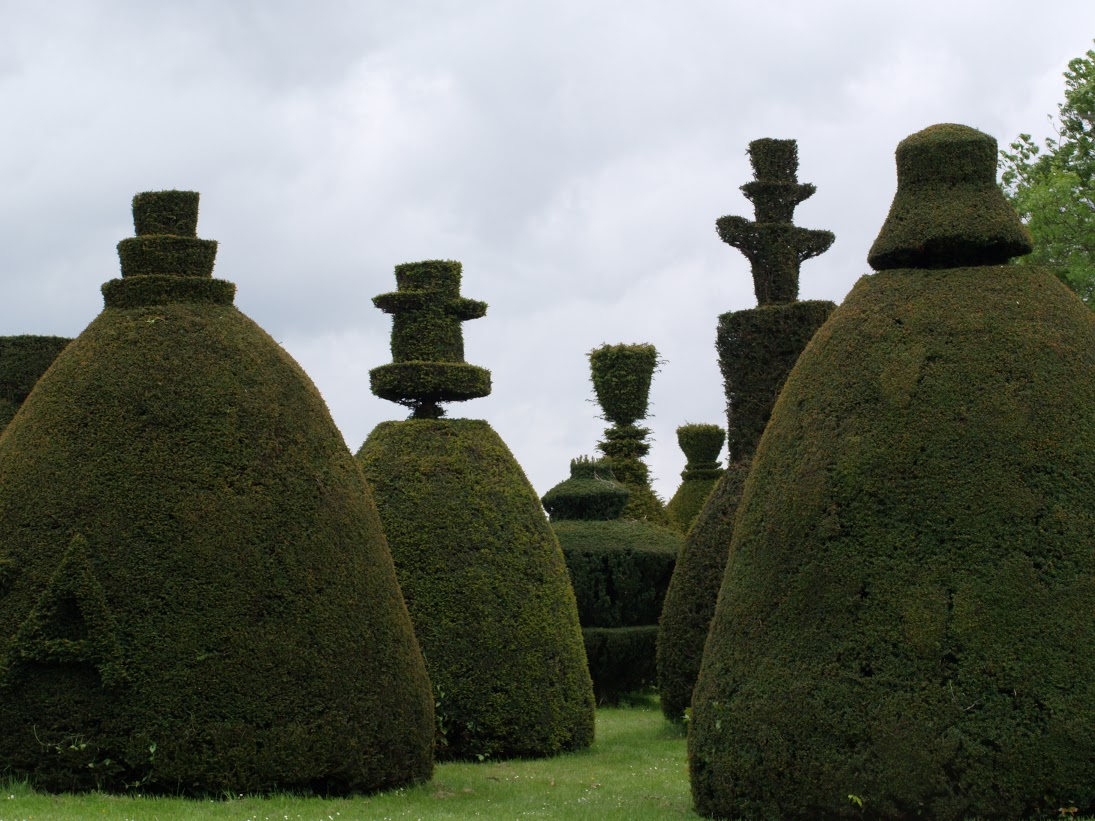
What the well dressed tree is wearing this year.

A procession of girls moves jauntily down Oxford Street. Each girl carries an identical Gap carrier bag and wears brightly coloured skinny trousers. The legwear ranges through many colours and materials – there are 23 different types in the shop.

It took me a while to realise it was an advertising event. Initially I just assumed that ‘Jeggings’ had really taken London by storm, either that or Mayor Boris had passed a new bye-law banning big trousers.

How tempting was it to join that line? So called ‘modelling’ is one of the strongest determinants of human behaviour. But by the time I had got into those trousers the line would have reached Tottenham Court Road and disappeared.

Some animals are hard-wired to behave exactly the same as their neighbour, making possible formations like shoals of fish and flocks of starlings. Someone explained to me that starlings and fish do not need to be particularly clever to pull off this trick. All they need is the instruction ‘do the same as the one next to you’.

Humans like to create this effect too, in Busby Berkely movies for instance or the Red Arrows air display team.

We are used to seeing similarly clad people in other contexts, such as children in school uniform and North Koreans in boiler suits. We like to be wearing the right things.

A demonstration of modelling behaviour is one of many attractions to be found in the local shopping centre. Since social services closed all the day care facilities, shopping malls and libraries are the best places to hang out to keep warm.

Compared with the library, the shopping centre is quieter and more studious in atmosphere. Also there are more books to read.

This part is vital – before you visit the shopping centre – establish the goal. On this occasion the target is: 1.To experience the sensation of being out of place; 2. Not to respond to this sensation by buying something.

For your day out, start by re-framing the shopping centre as a kind of art gallery.

All the familiar shops / exhibits are there (not you Woolworths). There are lots of things you can do free: try out the mattresses in John Lewis, try on lots of jeggings, use the computers in PC world to look up reviews on the same model you are trying, so you can spurn the attentions of the salesperson, use the cameras to take pictures of other people testing cameras on you, try on tester perfumes and marvel at their interesting names.

Or go into Superdrug, and ask for a super drug, such as beta interferon. Ask why they call themselves Superdrug when the best drug they have is ibuprofen.

My hypothesis is that shopping behaviour is a sublimated form of hunting, or at least gathering. The important thing to remember is that all the fun is in the hunt, and once the quarry is cornered then the fun is over. It is all about the expectation of reward – pulling the trigger on a purchase is entirely unnecessary.

Buying something is like coming home from a day’s fishing with a small trout you could have bought in Morrison’s for £3. The trout’s dead eyes communicate to you: So what?

You should have thrown it back in.

Things are not always what they seem, and shopping malls allegedly have a purpose beyond amusement or art.

Shopping malls are meant to part people with their money, rather than act as a recreational facility for escaped psychiatrists. The architects and designers have put in some subtle influences to work on your mind.

One of these is the so-called ‘Gruen Transfer’. This is a place, within the centre, that is designed to disorientate people, by using a combination of unusual shapes and textures and lighting, often accompanied by Muzak.

Apparently the effect is similar to a unit of alcohol or other anxiolytic. People slow down through the Transfer, and co-incidentally this is where the higher priced items are located.

I am not convinced that there is a strong evidence base for the Gruen Transfer, or other devices perpetrated by the advertising industry. Certain low budget shops seem to generate the same emotional disruption.

The oddly named B and M store, sometimes sub-headed ‘Bargain Madness’ can induce such profound despair that it could probably be used as a testing lab for possible new antidepressant compounds. Here the store has been less discreet about its use of disorientation – the clue perhaps is in the word ‘madness’.

Agoraphobics, who tend to have panic attacks in shops, seem to dislike places where there is no clear sightline to the exit. The entrapment induces a sense of doom. Though Morrison’s have an excellent range of vegetables, the way they are laid out can set a person on edge.

Individually, fruit and veg items are not threatening, but when they gang up like this, piled high on all sides, it creates a kind of jungle effect reminiscent of Apocalypse Now.

Another piece of (probably bogus) psychology I have read, relating to supermarkets, is that people have an ‘innate tendency’ to gravitate anti – clockwise. This led to supermarkets placing their main entrances on the right hand side of the shop.

If it was on the left, people would just drift further leftwards into the vegetables section and beach themselves in the courgettes.

Staff would come out to spin customers into the next section, like fairground attendants on a waltzer.

I wonder if it is different in the southern hemisphere, or for the left handed?

It is perhaps a little frightening to think that someone has manipulated the environment in such a way that you have unwittingly bought yourself an expensive, weirdly named perfume.

I am not just referring to ‘Obsession’. What about ‘Hypnotic Poison’, ‘Crazy in Love’ and ‘Thallium’? The internet tells me there is a perfume called M-75, which is the name of the rocket Hamas fires into Israel.

Perfumes, like the Gruen transfer, and the clockwise supermarket, are designed to create an altered state, but what exactly is the state of mind called? In the case of perfume, if it isn’t the name, it is probably solvent intoxication.

Or perhaps it is the feeling of being out of one’s element, or out of step with others. A warning that you are on unfamiliar territory.

Behaviourally, it is supposed to trigger a purchase decision.

The purchase decision is a learned behaviour that creates comfort, possibly by stimulating the ‘anticipation of reward’ section of the mind. The unsettled feeling is briefly quelled, only to be replaced by regret that you have suddenly become poorer and the shop richer.

How comforting is it to be in a herd of people all dressed appropriately and behaving in the same way? Enough people must love formations of soldiers to make it worthwhile dressing thousands of people this way and arranging them in large city parks. Everyone seemed to love the Olympic opening ceremonies.

Lots of people like to be in queues, and will probably join the end of any queue if they find one. If other people are after something, instinct says there is probably something there to have.

There is often not much to be found at the end of a motorway queue, which is formed by the pulsatile dynamics of traffic flow rather than obstacles, but the queuing instinct has evolved over the lengthy period of human history before tarmac and has not yet abated.

The instinct to behave like the person to the left of you is deeply rooted and possibly imprinted at an early age. Experiencing the feeling of being in the wrong place or in the wrong outfit is deeply discomforting.

Many people hate the moment in a restaurant when they have to set out to find the toilets. The fear is not that they will never find the toilet, but rather they will make them-self look foolish to others by dithering round the restaurant.

That is why I think it is a very tall order for CBT to try and get people to fight the idea that it matters a lot what other people think of you.

In the golden era of CBT, pioneers tried to attack this set of cognitions using grand behavioural tasks.

Albert Ellis, pioneer of CBT and our hero, in his list of the top 12 Irrational Ideas, included this as number one:

‘the idea that it is a dire necessity for an adult human being to be loved or approved by virtually every significant other person in his community’

Loved? Maybe not. Approved? Maybe not? But thought to be wearing the wrong trousers? I’m afraid it’s a deal breaker.

Maybe it shouldn’t matter. Maybe not as much. Certainly try and test how much it matters. Certainly try and get it back into proportion.

But it just does.

That leaves us with a burning question. If it is so important to blend in with everyone, why do certain people do everything they can to attract attention to themselves? For instance by dying their hair a florescent colour?

This is perhaps the exception that proves the rule, since these people are relatively few in number, especially in professional groups like accountants or dentists.

Several answers to this – you choose the one you like best:

So that they are visible in traffic?

Reaction to feeling left out or insecure?

Mating ritual?

Group or gang identity?

Genuine lack of insight about how they look?

They are doing a CBT assignment to reduce the irrational cognition that it matters what people think about them?

11. Tackling hooligans with a simple checklist.

Image

Your quiet reflections while driving to work are rudely interrupted by an idiot screaming past you in a small hatchback, overtaking the whole line of traffic, narrowly squeezing back in, missing a Portuguese pig lorry by inches.

Hooligan.

Your colleague interrupts his outpatient clinic with a brief diversion onto the internet only to suddenly find he has bought a 1995 Harley Davidson Fat Boy on ebay.

Hooligan.

Such events interrupt our attempts to look at the world as a sensible and logical place that only needs a few tweaks to make it perfect. The mind tends to create a fantasy world to live in more comfortably, and this explains dogs, fluffy toys, scented candles and soap on a rope.

Plenty of people will help us build the world of our dreams, not least the media.

Imagine the mind as a daily newspaper. Though the mind probably does not have an editor in chief, it has an editorial committee made up of opinionated people like taxi drivers and Irish nuns.

Yours may be different.

Plenty of space is devoted to current events, but even more is devoted to gossip and scandal. Quite a bit is devoted to food, clothes and the pursuit of food and clothes. The sports and health pages are also mainly about food and clothes.

Depending on the make – up of the committee, the mind can create very different sorts of world view. The Daily Mail mind for instance is quite suspicious. The Guardian mind feels it is being exploited. And the Sun mind is interested in sex and crime.

Since the concept of Depression as an illness calls for a change in a person’s usual world view, we have to imagine an editorial committee whose usual members – Fiona Bruce, Jeremy Vine and Hugh Grant – have been replaced by Leonard Cohen, Salvador Dali and Rev Ian Paisley.

Suddenly the world is transformed; distinctly darker, and quite unbalanced. Instead of Animal Hospital, as a change to a our usual programs, we now have live cockfighting from Wolverhampton.

CBT is an attempt to create a new committee instead of doom-mongers. The idea is to cut out the stuff about war and pestilence and put in more restaurant reviews.

It is tempting to think that resetting the mind’s information filtering system can bring about a more positive outlook, and this in turn could brighten the mood.

An old fashioned CBT technique, I think it was called Mastery of Pleasure, (or was that a sex manual?) involved creating a written timetable of your whole week, giving each activity a score between 1 and 10 depending on how much enjoyment it generated.

For example, watching Manchester City would score 6, while loading the dishwasher would score 7. This created a clear overview of the week, both in terms of quantity and quality of time.

Then, by substituting more dishwasher loading for football watching, your week would be improved, and more importantly, you would have disproved the notion that you had no control over how you felt.

It’s lucky that Mastery of Pleasure (or was it a postgraduate degree?) was not widely disseminated, as I suspect it is a technique that could easily turn our world upside down.

Imagine, calibrating everything, and finding, as we would, that 90% of our time is wasted on completely unnecessary items.

Luckily, Mastery of Pleasure (or was it a porn novel?) teaches people to rate their activities for pleasurableness rather than usefulness or necessity. Nevertheless, it calls upon them to re-evaluate what they find pleasurable, and if possible, substitute more pleasurable activities into the schedule, so that the whole average pleasure rating starts to increase.

There is some very interesting psychology involved in how people summarise pleasurable experiences, but one example is the case of the CD with a scratch on it about a minute before the end.

Has the scratch ruined the whole experience? What about the previous 49 minutes of pristine music?

Pleasure does not work like kilowatt hours, where we simply multiply power and time to sum up the energy used. Pleasure does not total up like the area under a curve on a graph, because the rating is given retrospectively from memory.

We also know that the beginning and the end of experiences carry more weight than the middle bits, which is why brevity is the soul of wit and why ‘The Archers,’ even at 12 minutes long, can get away with an absence of dramatic content between minutes 2 and 11.

What are the implications of moving the calibration system for pleasure from the automatic to the reflective mind? The danger is that certain activities may face a downgraded credit rating.

Some activities are probably best left to the automatic part of the mind. We could include sex, jazz and the tennis serve, which can all be affected by performance anxiety.

Once you start to rate pleasure, you may risk killing it.

I have already commented on the illusory joy of pets. But what about clothes and the pursuit of clothes, the activity called shopping? What about old stalwarts, like watercolour painting, banjo playing or golf?

What about photography, now that it is all digital? Techniques like solarisation and bas relief, that in the old days needed hours of darkroom work, involved getting contact dermatitis from putting your hands in developer, ruined your carpets etc, now can be achieved by moving a slider on a computer screen.

It so easy to make absolutely beautiful artwork using Photoshop or similar, that, suddenly, it loses its appeal totally. Such is art. It appears to need ingredients of toil and hardship to make it valid.

The notion of suffering being necessary to bring any value to an experience is borrowed a bit from religion, and also from the series Fame. Work is the price you pay. No pain no gain etc.

But how can we include items like suffering and pain in our Mastery of Pleasure (or was it a pirate ship?) timetable? Would it do suffering justice to simply rate it as zero?

Religions are always having to try and explain why terrible things happen, and this must be a massive burden for religious professionals. Why did God allow David Bowie to make the Tin Machine albums for instance?

Along the same lines, and probably to answer the same questions – only about world war and genocide – Freud developed the notion that people had a kind of death instinct.

Possibly this inspired Michael Winner to make the Death Wish movies. Though Freud would probably have put more effort into developing the main character, Paul Kersey, played by Charles Bronson.

As well as being a vigilante, Kersey was an architect. His building designs are only shown briefly, but he appears to encourage clients to save a lot of money by using a cheap building method just a little embellished by post-modern decoration.

These short cuts mirrored the corner cutting he brought to the criminal justice system by acting as police, judge and executioner all at once. I do hope Death Wish gets re-made with a lot more architectural referencing (see Point Blank).

Kersey has to choose between a civilised, measured and incremental approach to justice, using proper channels, or facing his hooligans head on and shooting them.

It is difficult to accommodate a drive toward death and destruction within a model that attempts to micro-manage pleasure activities, unless we just accept it as an elephant in the room we have to work round, covering it with a floral throw and scatter cushions.

Unless we try and accommodate destructiveness as a more understandable behaviour.

Kersey, like many other movie heroes, became a hooligan himself, but the audiences tended to view him as a necessary evil. People seem to want to subvert the usual processes of justice every now and again by acting completely out of character and possibly violently.

Kersey’s violence was initially triggered by revenge, but turned into a social mechanism, like pest control.

Many acts of seemingly random violence, such as ‘Running Amok’, have been construed as social mechanisms that redress some long lasting injustice.

In updating the psychoanalytic model of the mind, the ‘object relations school’ coined a character called the ‘internal saboteur’.

As far as I can understand it, object relations concerns itself with the very primitive mind and its development in the first few months of infancy. This is before the time when a person knows that he is a separate person and can correctly assign his experiences to inside the self or outside it. Conflict can occur in processing the aggression / guilt feedback mechanism. The object relations school seemed to focus a lot on breasts, so their world view was somewhere between the Guardian and the Sun.

I have trouble understanding object relations theory (you can tell), but we need to somehow include in our model of the mind a person – like Dr Zachery Smith in Lost in Space – who works behind the scenes to sabotage the ship.

(Or, even more evil, the Ian Holm character, Ash, in Alien – why is it that internal saboteurs are found mainly on space ships?).

Up to a point self – destructiveness can be explained as an attempt to get back at others or redress the balance in a power relationship. Sometimes it may be better to explain it as a short cut in making changes happen quickly.

I am reminded of recent attempts to fix small electrical appliances such as toasters. There comes a point where the attempted repair turns into a post mortem, the turning point being recognition that the appliance was never designed to – and cannot – be disassembled.

Finally, pulling the two halves of toaster apart with bare hands or hitting it repeatedly with a rubber hammer bring about the desired outcome of an end to the toaster issue. A colleague tells me that this happens a lot with motorcycle repairs and is known as ‘the berserker phase’. Luckily, he is not a surgeon.

In fact people who harm themselves by cutting make the observation that the act focuses and resolves a moment of intense mental turmoil.

Not recommended and foolish, both for toasters and people.

Destroying motorcycles is probably a good idea though, in the wider scheme of things. In fact there is quite a lot of redundant junk and clutter in most people’s houses that is crying out for some rational hooliganism. If you have a cathode ray tube television for instance, you have probably wondered from time to time about throwing it out of the window. I worry about you if you haven’t.

Which brings us back to the problem of calibration of emotional states. It is very difficult to find the right frame of reference. If we subjected many activities to scrupulous measurement, we would have to categorise them as ridiculous and unnecessary, like carrot shaped trousers.

In using CBT to re-evaluate and re-schedule activities, we begin to ask ourselves some difficult questions. Why does everyone we know seem to spend all day looking at a computer screen? Aren’t they supposed to be an engineer / teacher /artist?

If they realised how they now spend their time, might they be tempted to destroy the computer with Greek fire?

And if we had to carry out a Mastery of Pleasure (or was it a Waddington’s board game?) exercise on, say, running a marathon, or digging the garden, or training a parrot to ride a unicycle, how would we measure the area under the curve?

When we encounter a hooligan in our mind there are several ways we can react:

Hug them (as recommended by the Prime Minister)

Shoot them immediately (as recommended by Michael Winner)

Run away

Using a wider frame of reference, attempt to understand the hooligan

Attempt to slowly reform the hooligan using metalwork and batique

Cover them with a floral throw and scatter cushions

Play them some Tin Machine

Depending on your editorial panel, you can choose any of the above options.

(Or was it a steam locomotive?)

10. Insuring the uninsurable.

ImagePendleton’s headquarters.

Might you get depressed one day?

If you answer yes to any of the following questions, this is quite likely:

Do you tend to play a Party App on your computer rather than attending a real party? Do you support a perennially unsuccessful football team? Has everyone in your extended family been treated for depression? Do you regard your pet snake as the best friend you have ever had?  Have you been depressed every single day of your life so far?

Depression is likely to affect a sizable minority of us at some point. I’m skeptical of surveys that tend to show practically everyone in some areas (Slough?) is suffering from depression, but suffice it to say it is a major common condition on a par with blood pressure or diabetes. So, is it worth insuring yourself against getting depressed? There are several reasons why not, at least in terms of popping into Swinton or calling Direct Line.

When we consider insurance we are embarking on what is now grandly termed Risk Management. By this is meant that we need to look into the possible future and explore some hypothetical events, such as burglary or fire. Whether we might get ill or not is rather hard to predict. And also it is something we are most reluctant to think about. Some people do take out health insurance, but most of us do not.  Perhaps the main barrier is thinking that it will never happen to us.

And people are right to be skeptical about the insurance industry. Everyday someone texts me to urge me to claim back mis-sold PPI. Please can we go back to Nigerian banking scams? I have never seen a specific Mental Health Insurance Policy, though some aspects of mental health may be included within a wider health policy. Why?

First – insurers tend to specialize in more concrete types of illness like cancer or heart disease. They like to know you have not had previous episodes of the same illness. They like to be able to say categorically whether the illness has happened or not, whereas a diagnosis of depression often falls within a grey area.

Second – depression is so common that the premiums would likely be very high and riddled with snags and get out clauses.

And third – it’s not as though you can really buy a guaranteed effective treatment with your payout. The treatment of depression is as much a lottery as selecting an appropriate insurance policy.

A policy might pay out to protect your income if you cannot work due to depression. But this can lead to a horrible situation where a person is locked in an insurance- perpetuated sick role, much like the benefits trap, where it makes sense financially to continue to act like a depressed person.

But there are other ways of insuring against depression, without troubling the man from the Pru, or his modern day equivalent, lurking in the dark recesses of a Sunderland call centre. (Just redressing the north south balance, having mentioned Slough earlier on.)

Be Prepared, as Baden Powell advised. I am sure he meant this in a specific and practical way, such as keeping a spare credit card in your sock. Preparing for very unlikely events, such as a Harlem Shake breaking out in the library, or the invention of punk rock, is beyond the scope of ordinary scouting.

Can we prepare for Depression? I am referring to getting the roof of the house in order before the rain comes, as David Cameron would probably put it.

When depression hits, the mental functioning is decreased in certain key areas such as reduced concentration and energy levels. That means, if you are stretched to function properly even when you are well, then when you get depressed you may go under. That will lead to a vicious circle of more stress caused by failing to keep up, leading to worsening depression. Finally comes a crunch point where things officially go to Hell and High Wycombe.

That means if you are well at present you should be operating with spare capacity. What does that mean? I’m not your mum, but ideally:

You should keep at least a million pounds in your current account.

OK, that’s stupid, but: You should have a system for organizing and dealing with any paperwork including financial stuff. You should know where everything important is, like your birth certificate and passport. In particular some way of keeping the electronic passwords you need for online banking etc. You will never remember them if you get depressed, and you won’t even remember where you put the bit of paper you wrote them on. Then you will worry that you have lost the bit of paper or worse, someone has got the bit of paper and has taken your money. Morbid thoughts about poverty and ruin are common in Depression, and  suspicious ideas about others can occur.

So, strategy one is the tin box. Ideally take the biscuits out first and eat them.

Strategy two is more complicated, and involves working out your attitude to certain key issues. What is my policy on taking medication? What is my threshold for making an appointment with the doctor?

Strategy three is making sure none of the library books and dvds are overdue. Think how those fines could mount up.

It is clear that Risk Management is something of a myth when it comes to individuals. Actuaries – experts in statistics – work with very large sample sizes, for instance in predicting how long people will live. That makes it possible to run pension schemes and predict how much money will be paid out in future years.

When the sample size gets smaller, the effects of chance become much more significant. We have a similar problem when it comes to predicting the behavior of individuals. In particular we have been carried away with the idea that we can predict violence and self harm. We could probably predict a homicide rate for the whole population, but for smaller samples or individuals we might just as  well throw dice or read the tealeaves.

In fact a rather cynical movement has broken out within mental health work, which goes as follows: We are scientists of a kind, and we know that it is impossible to predict violence or suicide in individuals with an accuracy that could affect our practice.

Recognizing however that we work in a political context, we know that the standard on which we are judged will not be: Did a Homicide / Suicide occur? but rather: Was everything done, that should reasonably have been done, as judged by the man on the 7.15, to have prevented the tragic event?

Luckily, medical services tend not to give written guarantees, acknowledging that we are hardly in control of all the variables that predict how illnesses will affect people. Even Dixons, perhaps especially Dixons, do not guarantee that things will not go wrong. They only guarantee to fix or replace the  eg Beko if it eg explodes.

Patients cannot therefore expect infallibility, but only ‘reasonable care’.

Aware of the political context, clinicians have created an ingenious analogue of what looks like reasonable care, just in case something goes wrong. Take for instance the so called HCR20 scale, which purports to predict risk of violence.

It has a series of numerical scores, which must not be added up to make a sum total. The main function of the scale is that it shows you have considered the proposed risk factors and given some thought as to what might happen in a range of future scenarios.

Calling it ‘arse – covering’, as I heard an angry service user describe it this week, is inaccurate, as such a process is just as likely to create unexpected new buttocks.

Very few health managers and even fewer politicians are experts in statistics. It would be nice to see more actuaries in parliament. I can’t help thinking that actuaries need better PR compared with lawyers, such as a hit TV show. There was never a show called ‘Sun Life: Miami’, for instance. Or even ‘Canada Life: Canada’.

Based quite a bit on ‘Minority Report’ a theme could be a panel of (maverick) actuaries who have learned to predict actual events – sudden deaths – in individuals, rather than just rates in large populations.

Using the dark arts of prediction – going against the fuddy-duddy regime at the Institute Of Actuaries – they would race round to the person’s house just in time to stop the victim poking metal forks in the toaster, or mistaking the Paraquat for Green Chartreuse.

The hero would be called Pendleton I think, and he would drive a lightweight trail bike or use parkour to beat the inevitable traffic jams.

In the first episode Pendleton would skim a CD copy of Microsoft Excel disdainfully into the river.

Each episode would end with a party at Pendleton’s cool loft apartment, and include a minor accident he had foolishly failed to predict, such as a champagne cork hitting someone on the forehead, or someone breaking a tooth on an olive.  ‘I never saw that one coming’, Pendleton would chuckle.

Health managers and Inquiry panels would announce, ‘what we need here is a Pendleton’.

Preparation is not the same thing as insurance.

Both depend on subjective assessment of risks and putting documents in a tin box, but for insurance you need to haggle with another person and give them money.

Its quite likely that subjective risk assessment is impossible beyond simple and likely events in the very near future. Beyond that we might as well use random number tables or a horoscope (which are the same thing).

By the way, there’s a free copy of Excel floating in the river.  And is that a trail bike I can hear in the distance?