52. Finding yourself and more importantly, your keys.

Image

A picture with a mental health sort of vibe, suitable for a leaflet, no sensible offer refused.

Two girls walk slowly to school alongside each other, both talking into mobile phones, possibly to each other.

A man in the public library, reading the newspaper, who moves his finger along the lines of print and whispers the words out loud.

An electrician, talking to his assistant, explains what he is doing as he puts in a new fuse box. He deliberately gives himself little electric shocks at times, explaining that this is something you should never do.

A man clutching a can of Special Brew, talking loudly, seemingly to no-one, as he staggers down the high street.

A kid, pretending to be CIA, talks into his sleeve at quiet moments during a history lesson.

I’ve been observing people talking out loud, and – heresy! – I’m just wondering if there shouldn’t be more of it.

Here’s another unpopular view – I always preferred the original release of Blade Runner to the subsequent versions, simply because of the Marlowe style spoken narrative. We’ve had ‘the final cut’, but I hope there will be more versions, for instance, a musical, with tap-dancing robots.

All this stems from the realisation that we are all several people in one. The idea that we are ‘an individual’ is handy for practical purposes, such as issuing passports and driving licences, but manifestly an oversimplification. Discarding for a moment oddities like multiple personality disorder, we spend a lot of our time in different modes of operation.

Dreaming, day-dreaming, fantasising, imagining for instance. Set on autopilot as we drive to work, often not remembering all the mini roundabouts and small mammals we drove over. Or reverting to chimp mode when there is a perceived threat.

In people who suffer from psychosis, this potential for multi mode operation has been called ‘double bookkeeping’. The ancient example is a patient who is deluded that he is the King, but is content to mop the hospital floor as a day job. Real life examples are frequent enough. One of my customers thinks he is the most senior officer in the British Army, but he is happy to work in the snack bar on a voluntary basis.

There is no need to be psychotic to indulge in double bookkeeping. The phrase ‘creative accountancy’ goes back a long way. Look, for instance, at the target culture of the modern regulated public sector, where information is routinely falsified. I even had trouble typing that word, falsified. I wanted to type ‘spun’ or ‘distorted’ or ‘laundered’, such is our reluctance to attribute malicious motivation. To call someone a liar is a serious insult and perjury can carry a jail sentence. Are all these managers and civil servants who cook the books consciously aware that they are lying, or are they using a series of mental mechanisms to justify themselves?

My hypothesis here is that it is easier to lie in a diagram or a document than it is to lie out loud. Speaking out loud seems to engage bits of mental functioning that are more careful and scrutinising. If you lose your keys, if you speak out loud the word ‘keys’, you are more likely to find them. Hearing yourself out loud seems to kick the awareness level one layer higher.

Apparently negotiations go better if you speak in the first person and include some ‘feeling’ words. If you happen to citizen’s arrest a former prime minister, be sure to mention you are disappointed with some of his bombing decisions and surprised that he thinks he can walk freely around Shoreditch, amidst Hipsters.

If you appear in court, and you hear yourself swear to tell the truth, the whole truth and nothing but the truth, you probably will. Talking to yourself is the new talking to someone else.

And that brings us to new technologies, like Siri and Google Now. If you hear yourself say, ‘is there a good japanese noodle bar round here?’ you will immediately realise that you are being silly. You don’t like noodles and you’re in Rotherham. You don’t need the latest phone, or any phone at all, you just speak into your sleeve.

That’s got implications for psychotherapy, and for the church, which has never successfully marketed its Confession product. If the magic ingredient is simply speaking out loud then you don’t really need the therapist or priest. You could dial 111 and explain your problems over the phone – just unplug it first.

50. Taking Canadian Living more seriously.

Image

First, cement each of the six guitar strings to the guitar. Then, cement the guitar to the James Blunt figure. Now, cement the James Blunt figure to the tank controls…

When I was about 7, I had a book called ‘365 Things to Make and Do in Nature and Science’. To be honest, many of the projects were frustrating, as it was difficult to obtain the necessary parts and materials, some of which were quite exotic. In our town it was very hard to obtain, say, an old altimeter from a WW2 German bomber, or a tin of gunpowder. There was also the obvious problem of leaving one day relatively unstructured during a leap year.

Until now, I have never questioned the idea that Doing Something is a worthy use of time, as compared with Reading Something, or Watching Something. But now, typing with a bandaged thumb from an unfortunate slip of the Stanley Knife, tennis elbow on both sides, from excessive screwdriver and spanner activities, and lower back pain from heavy lifting, I’m forced to ponder whether it’s time to say goodbye to B and Q and that new yellow brick road I was planning.

The Nike slogan, ‘Just do it’, is now 25 years old. People were tougher in the eighties – if coined now,  that slogan would come with a number of provisos and safety warnings, such as adding: ‘once you have checked with your cardiologist’ or  ‘providing you are Corgi Registered’.

Though Nike do not state this overtly, their motto asserts a behaviourist stance on life which I interpret as follows – you are what you do. There is a worthy theory underpinning this outlook, stemming from the psychology of self – perception. From what we find ourselves doing, we infer who we are and what we stand for. I am sitting at a computer, wiping blood off the spacebar, so I am a dedicated writer. If I had a Scotch, a full ashtray and a loaded revolver on the desk I’d be even more dedicated.

Last year, as further evidence of a shift from behaviourism toward ‘cognitivism’, Nike took the ‘just do it’ campaign in a new direction: Possibility.

With ‘Possibilities’ we’re taking ‘Just Do It’ to a whole new place, showing people a new way to set goals and think about their own athletic potential’

Thinking about our athletic potential is quite cognitive. If you are taking a penalty shot or serving at tennis, the last thing you want to do is think about possibilities. Probably the one time David Beckham thought about possibilities was the time he shot the ball twenty feet above the crossbar.

Apple’s campaign ‘Think Different’, invented in 1997,  also seemed to pursue a cognitive path. 29 famous ‘thinkers’, such as Albert Einstein, were included in the campaign posters. But if we look more closely at the list, we see that many if not most of the ‘thinkers’ were actually artists or musicians, i.e. people who held tools in their hands, made grooves in vinyl or canvas and left a legacy of artefacts and occasionally accidentally cut their fingers. In fact, none of those featured in the ads were Philosophers, unless you count Kermit the frog.

‘Here’s to the crazy ones’, ran the script,  ‘The misfits. The rebels. The troublemakers. The round pegs in the square holes. The ones who see things differently. They’re not fond of rules. And they have no respect for the status quo’.

The script seems to owe something to Top Gun, where, rather lazily in terms of character development, the hero was named Maverick.

We probably know many such mavericks, but they have never become well known or achieved much, because they thought too much and didn’t do enough. In Britain they would mainly be described as harmless eccentrics. On the other hand, those who made it into the ranks of Think Different were prolific doers. Alfred Hitchcock made over 60 movies for instance; Bob Dylan made over 40 albums.

Maverick couldn’t wait to get catapulted off an aircraft carrier and frighten the MiGs.

I just collected a Depression Leaflet from the doctors while I had my finger looked at.

In the ‘what can be done?’ section there is a bit of practical advice as follows:

‘Vary your normal routine, get out and about if you can, keep occupied if possible, if you can’t sleep, try watching TV or listening to the radio.’

In search of useful things to do I turned to ‘Canadian Living’ magazine. I found an article called ‘Fifty good deeds for fifty days’, which borrows a little from the Random Acts of Kindness movement.

Like ‘365 things to make and do’ however, some of the materials are hard to find. For instance I have no ‘well behaved dog’ to take to visit elderly people, nor any fresh cut flowers to leave at a nursing home. If I happened to buy some pet food at the supermarket to take to the local animal hospital, I’d probably buy something they weren’t allowed, like cream buns.

I’ve come up with these ideas instead, which I’m hoping Canadian Living will publish:

  • Wearing a salvation army jacket and carrying a clipboard, feed parking meters that are about to expire – not for Audi drivers though
  • Get everything out of your food cupboard and throw away any packets with a sell by date before you were born, or 1963, whichever is more recent
  • At Tramshed, in Shoreditch, try and make a citizen’s arrest on Tony Blair.
  • Find a pothole in the road, chalk round it in yellow and report it to Fillthathole.org
  • Place a small whiteboard in your toilet, headed: ‘This toilet was last checked at…’ Then sign with a fictional name and date, such as Attila the Hun, 453 AD.
  • Install Windows 8.1, but first say goodbye to everything you have on your computer, it’ll be like new
  • Phone up Santander Bank at 5.30pm and ask them to answer a short feedback questionnaire, regarding your performance as a customer
  • Phone up the bursar at the University of Leicester and ask for a cash donation towards your holiday in the Bahamas

In other words, don’t just think different – do different. Or differently, if you prefer .

49. Saying no to Mister Kipling.

Image

My new laboratory

Outside Ladbrokes, it occurs to me that behavioural psychology, one of the greatest discoveries of the twentieth century, has fallen, like that other great Russian invention, the Kalashnikov, into entirely the wrong hands.

Clinicians have neglected behaviourist explanations and treatments for mental health problems, leaving these dark arts to commerce.

Though still called cognitive behaviour therapy, CBT has edged out the behavioural aspects, such as facing feared situations in real life, or reducing unwanted repetitive actions like texting during mealtimes.

The move towards Mindfulness has taken things even further in this direction. Whereas behavioural techniques can be applied successfully to animals, mindfulness cannot. Herein lies the problem. Therapists are most reluctant to regard the human being as an animal, whereas it suits some commercial interests for people to act like plankton.

In fields such as gambling, shopping, advertising and food, simple behavioural strategies have proven to be devastatingly effective. By placing rows of sweeties either side of the checkout in supermarkets, or sending a tinkling food cart slowly but surely up and down planes and trains, we are made to drool. Our sense of scale is disrupted, by selling massive chocolate bars for £1, next to tiny versions for 65p and three-for-two offers. Greater consumption seems to make sense.

Behavioural interventions like graded exposure and exposure response prevention are too dangerously similar to common sense to warrant an exorbitant fee in clinical practice. Whereas a gambling machine or a chocolate bar has no problem reducing you conceptually to the role of laboratory animal.

I’m just dreaming up another screenplay, which is for a re-make of Traffic, but with people addicted to sugar instead of heroin, with fat actors instead of thin.

I’m hoping it’ll get funded before the current moral panic about sugar dies down. The idea is to examine ‘the sugar problem’ from different perspectives, from politicians and big business on the one hand, to the crowds of diabetics camped outside Clinic 16 on the other, via the sticky pavements outside KFC.

Here’s the background theory as I understand it, simplified for the movie:

1. For some reason, the USA has a big corn syrup industry and puts corn in all kinds of food products.

2. Fructose, made from corn, is sweeter than glucose and has less feedback effect on the brain, leading to over-consumption and frequent trips to the Spar shop.

3. People get more tolerant to sugar, increasing their consumption progressively.

4. They may experience craving and withdrawal effects similar to chemically addictive drugs, leading to sugar addiction

5. Sugar tweaks the dopamine and endorphin pathways in the brain. These are shown diagrammatically as massive cables connected to the addiction box, which is sited just behind the nose.

6. Recognising they have an addictive product on their hands, the food industry takes advantage, increasing the sugar concentrations, fructose content and portion size. 500ml becomes the new 330ml. We are asked at food shops if we want to ‘go large’ and we say yes. Shouldn’t there be a consent form for such a far reaching decision?

7. Big Sugar runs a clever diversionary tactic, blaming Big Fat for everything.

8. The insulin manufacturers get richer.

9. Politicians propose a Sugar Tax, forgetting it was an OMD album and they probably still have copyright.

10. Grand Designs features an edible house made of Glacier Mints.

Did the mental health industry play its part in the great sugar rush? At first sight, it looks as though our hands are also sticky. Mainstream psychiatry demonised the use of amphetamines, barbiturates, benzodiazepines and antipsychotics as tranquillisers, while promoting ‘atypical antipsychotics’ that were strongly associated with weight gain. Psychiatrists promoted the concept of addiction and started applying it to things increasingly difficult to compare to heroin, such as chocolate, sex, darts and embroidery. As a result, the concept of addiction has become a metaphor for any repetitive pleasurable behaviour that has a downside.

The mental health industry is buying into the idea that drugs and even foods have power over us and may enslave us if we weaken. In terms of reducing the crowds at clinic 16, will it help to regard sugar as an addiction? More likely it will prove counterproductive to empower sugar by deeming it a chemical of substance. There’s no denying that sugar is a powerful ingredient – the taste for sugar is hard-wired. After all, it’s only competing with three other tastes, two of which are bitter and sour. It’s a taste that children seem to love, but that many grow out of. But in the end it’s just a molecule, not a mystical power. Food and drugs are tools for us to use, not the other way round.

I’m pretty sure, in a double blind trial, I could not tell Coke from Diet Coke. Yet everyone I ask assures me there is a massive difference. There’s an urban myth that sugar intake creates a ‘rush’ or increases energy, even risking overexcitement. Who planted that idea in popular consciousness? Mars, perhaps.

As a debunking exercise, I did a small field trial on the so-called Death By Chocolate. Suffice it to say I survived. Should I have asked for my money back?

Image

The Death By Chocolate, before the experiment

Maybe the marketing men did not envisage how strongly sugar would catch on, given a combination of chemical and social reinforcement and low pricing. Companies say they have increased portion size and fructose content because people are demanding larger and sweeter products. A kind of forward feedback has occurred, and the moral is, conditioning is a powerful motivator.

How to end this movie then? One idea is to have all the dark psychologists who manipulate our food preferences arrested in a raid on Tate and Lyle? Or an upbeat ending with scientists discovering Baking Canderel? Or a line of addicts at the sugar clinic, receiving treacle in little pots, instead of methadone?

Incidentally, please do not attempt the Death By Chocolate challenge without medical advice. Sometimes these urban myths have a grain of truth in them.

44. Saying goodbye to Virginia, more sensitively.

Image

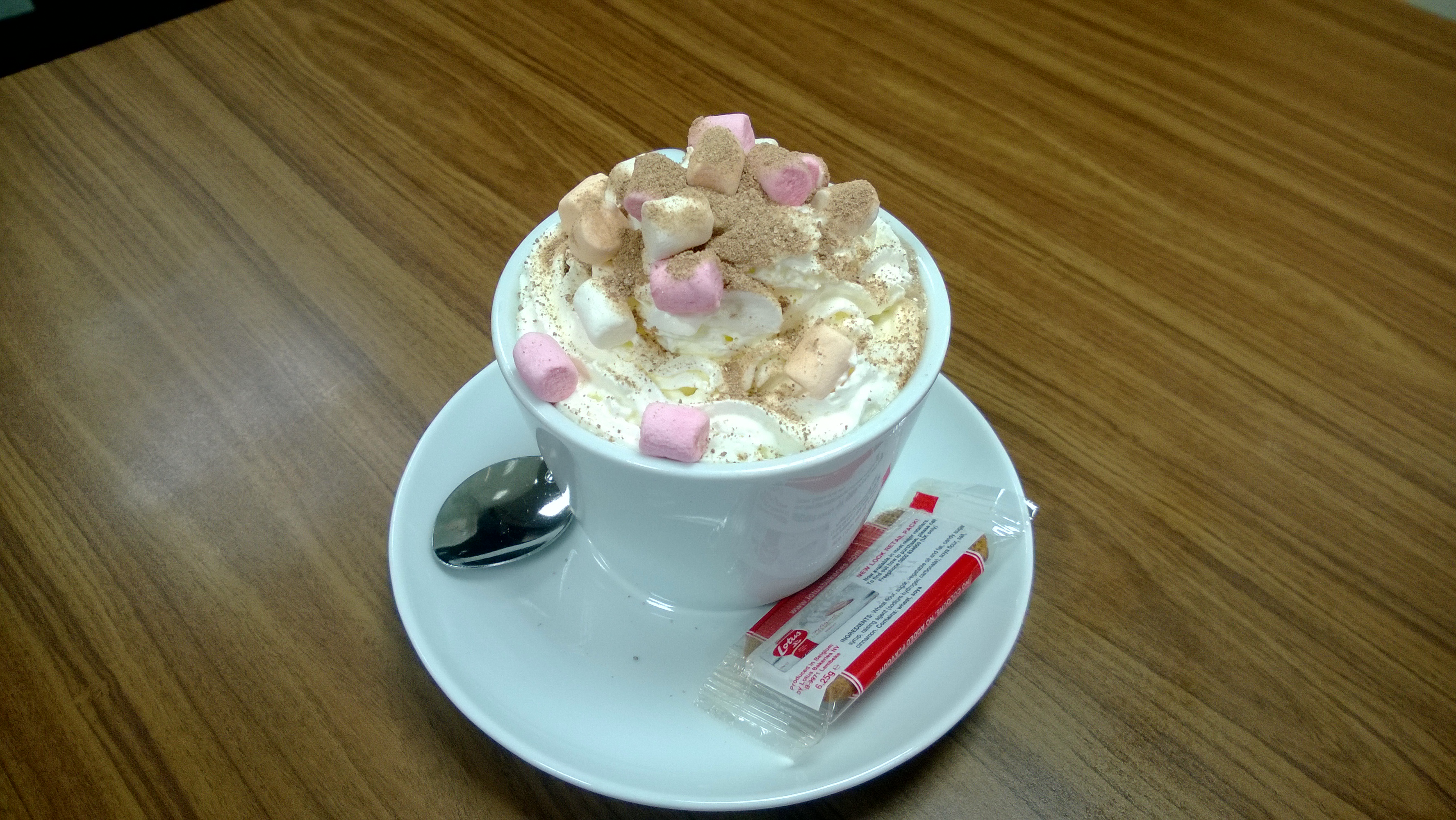
Marshmallow invasion: The first wave.

You might find this hard to believe, but it’s quite a while since I’ve been punched in the nose. Especially considering the number of times I have ‘misjudged the rapport’ with our service users. However, I just discovered a product called ‘First Defence’, which creates a very similar sensation, but without the violence. First Defence sounds like the name of an outsourcing company for mercenaries, or possibly the military wing of the bus company, but rather, is a product made by Procter and Gamble, to prevent the early symptoms of a cold turning into a screaming, streaming viral attack. It’s a kind of Early Intervention Service, in a little spray.
Many of the Early Intervention services for mental health problems have been scaled down or discontinued. However, there has been a refocussing of efforts to stop our patients going on to develop lifestyle-related problems such as obesity, diabetes and vascular disease. NICE intend to step up the anti-smoking component of our role.
For every new consultation, our first questions will be about smoking, exercise, diet and alcohol use. For our inpatients, nurses will not be allowed to facilitate or supervise them going for a smoke. Furthermore our nurses will not be allowed themselves to smoke, wearing any kind of uniform or NHS regalia, not even a Charter Mark badge from 1994, nor one of those badge / lanyard accoutrements that staff-not-at-risk-of-being-strangled wear round the neck.
Please note the new CCTV cameras behind the bike sheds.
You can see now why I started with the punch in the nose issue. Before the patient has a chance to tell us anything, we will have:
Recorded the names and ages of their children and where they go to school.
Made them sign a confidentiality agreement stating that we will shop them to the police or social services if they come out with anything too alarming.
Calculated their Body Mass Index, including commenting whether they are shaped like an apple or a pear. I could perhaps disguise that bit as a personality test – if you were a kind of fruit, what fruit would you be?
Guaranteed to break the ice, I think you’ll agree. We’ll hear about your problems shortly, as soon as we’ve got through my agenda.
Whether we can make a difference to patients’ lifestyle is rather dubious. A sceptic might point out that it is really difficult to treat obesity or cigarette smoking in people who are feeling fine, let alone those who are going through difficult times. Even well directed smoking cessation programs struggle to achieve a lasting effect beyond the first 6 months. By 12 months most people with major mental health problems are back on the weed. Yet, in anticipation of the NICE guidelines, the effectiveness of such programs is being ludicrously oversold, often by the same people who dispute the efficacy of medication for mental health problems.
Psychiatrists will not be allowed to stay out of the lifestyle war. Unfortunately, we have unwittingly caused part of the problem by promoting tablets that cause weight gain, and letting people smoke in our hospitals, to help them calm down. Most people with psychotic conditions like to smoke – upwards of 70%. In surveys they say they enjoy the experience.
The orthodox view is that cigarettes do not help people concentrate or relax. They merely reduce the effects of nicotine withdrawal the smoker is already suffering. We have tended to view smoking as a relatively minor problem relative to mental illness. Now we are being asked to make it more of a concern. This is all OK, except for the damage it might do to people’s relationships with their doctors and nurses.
Coming across as positive is one thing, adopting the tone of a sports coach is another.
Very few psychiatrists wanted to be PE teachers when they were little. It’s just a hunch. Many of my colleagues – let’s put it nicely – wouldn’t make it as underwear models. Are we in a good position to set the lifestyle agenda? ‘Mindful walking’, to us, is being careful not to trip over those yellow signs that cleaners leave on stairways. Some of us even remember what the inside of a golden virginia packet looks like.
We know from long experience that telling people what to do is a bad idea. We know from many surveys that people like us to listen to them. We know that genuineness and empathy are key therapeutic ingredients. Yet only this week a social worker, who had just detained one of our patients under the mental health act, told me she thought what would really help the gentleman concerned was a back-packing trip across Scotland, rather than tablets.
Luckily, there is no section of the act that mandates back-packing or cross-country running. Yet.

40. Holding’em, folding’em – or going nuclear.

Image

A man must know his limitations.

Some days you’re the windshield, some days you’re the bug, according to Mark Knopfler. When tackling a large outfit like a utility company, be assured, everyday you’re the bug. And when tackling the NHS, they are the Louisville Slugger and you are the ball, as Mark would put it.

Sometimes it pays not to fight on too many fronts at the same time – just ask Hitler.

One of the battles not to fight is with a large corporation. Private or public sector, it doesn’t matter, don’t tangle with it unless you have unlimited resources, a firm of lawyers and preferably an enforcer who works through ‘unofficial channels’ e.g. by re-arranging peoples kneecaps. And I don’t mean an orthopaedic registrar.

For example, though I should know better, I am locked in a pointless battle with Ovo Energy, which will only end one way. Every time they read the meter they record the night as day and the day as night, essentially adopting the world view of  a nocturnal creature. They purport to be a green outfit, and I suspect they are trying to be fairer to owls and badgers, who cannot at present benefit from Economy 7.

Large organisations are groups of thousands of people, with massive resources. You are one person with very little time and money, even if Erin Brockovich is your favourite movie.

There are several ways that people get hurt when they interact with large organisations, but the main effect is that of learned helplessness. Even Kim Kardashian can’t get British Airways to accept they have taken items out of her bags. Veteran complainer Clive Zeitman resorted to sending British Airways’ mouldy strawberries to their CEO by courier service*. As a result his daughters were invited to Heathrow to inspect the catering facilities. Personally I’d have suspected they were walking into a trap, like Clive might receive them back, also by courier, but not in one piece.

You might get an apology – but does an apology on behalf of a vast organisation actually mean anything? Customer relations usually frame an apology in a twisted way like ‘We are sorry that you feel unhappy and dissatisfied with our service’. The implication is that your feelings of unhappiness and dissatisfaction are your problem and relate to poor early life experiences.

They might as well add, ‘we hope with adequate therapy you manage to resolve your issues with your over-involved yet emotionally detached  mother.’

You might get carried away and become a single issue fanatic and pub bore. The organisation might even have you designated a ‘vexatious complainer’, which means they acknowledge your letters but don’t otherwise respond to them (no change there then).

And finally, having gone too far, having got personal with some hapless call centre employee, having bogged yourself down in nitpicking details, you are consumed with guilt and remorse and you realise you have turned into a monster. For instance in suggesting that there is really only one essential item in the meter readers’ toolkit of skills.

Worst of all, it might turn out you were wrong all the time. I have checked that meter so many times. I have taken photos of it and mailed them to Ovo. My dream is to get an eminent person – Desmond Tutu would be ideal – to visit the house during the day and observe the meter’s steady advance as I turn on all the appliances, then sign an affidavit as follows: ‘I Desmond Tutu, Archbishop and veteran human rights campaigner, winner of the Nobel peace prize in 1984, solemnly confirm that Reading One is Economy 7.’ How you like them eggs, Mister Ovo? [ovo=egg, gettit?]

Instead of signing, Desmond would probably advise me that the relationship between the strong and the weak, the big and the small, is far more complicated than a simplistic perpetrator / victim scenario. Butterflies should take care not to break the wheels.

As a participant in Capitalism, which is the only game in town, it is better to regard yourself as playing a game rather than conducting asymmetrical warfare. The paradigm of gaming means you choose your opponent wisely and play when it suits you. If you lose, its only a game (sucker).

Why do people hate large organisations so much anyway?  Perhaps there’s a limit to the amount of ‘putting you on hold’ people can take, even with Vivaldi in the background. It is very difficult, even for an able -bodied, able-minded person, to penetrate the ‘choice architecture’ that creates a force field around organisations. How difficult must it be for a person with impaired abilities to deal with ordinary issues like trying to minimise energy costs?

Is there such as thing a Corporate Psychiatrist? I don’t mean a psychiatrist who wears a smart suit, drives an Audi and carries a Blackberry, because there are none. No, I mean someone who can diagnose and treat ailments that affect large companies.

For instance, the power companies suddenly became incredibly unpopular and possibly evil.  Could that be seen as a kind of disease process? I have a friend who works for an energy company, who assures me the industry is not evil, not particularly profitable and not guilty of the various price-rigging allegations that are being promoted in the media. He hasn’t tried to sell me any energy yet, but I accept he might be working a long con.

My theory is that society has a certain quantity of Stigma within it, which is probably a constant total. Now that Stigma cannot legitimately be attached to disability or minorities, it has had to go somewhere, and seemingly it attaches itself to arbitrarily and lazily designated villains-de-jour, such as banks, newspapers or power companies.

If there is hope, it probably does not come in the form of EDF, but I am hoping that nuclear electricity will boil my kettle faster, so I am changing over. We are heading toward judgement day for the meter, as two giant companies slug it out in the cellar. Desmond, you could have stopped this.

https://elt.oup.com/elt/students/englishfile/dyslexicfriendlytexts/ef_int_reading_8a.pdf?cc=us&selLanguage=en

37. Rejecting the Domino’s Theory.

Image

This creature’s camouflage is poorly suited to the urban jungle that is Hull.

My iron is warmed up and the fire extinguisher is ready, but my Ironing Coach is late today. Let’s hope we can stick with simple shapes again and not attempt anything complicated like pleated trousers. I was never that good at thinking in three dimensions, which is probably why I am not a surgeon.

One of my theories is that Specialisation has been very bad for us. I can understand how such a thing came about, following the industrial revolution, the invention of production lines, and the division of labour.

But every time a specialism is created, such as Pastry Chef, Tyre Fitter, or Middle-Third-of-the-Duodenum-Surgeon, a potentially useful activity has been taken away from the rest of us.

Not only are we all deskilled, but also we now have three very bored people, doing the same thing all day. Nowadays it is possible and probably lucrative to have one very finely honed skill, particularly if it is one that has been professionally colonized and denied to amateurs.

Professionals, and by this I mean the old professions like Law, Medicine and Accountancy – I nearly said Prostitution – were the first to stitch up areas of activity which would become highly rewarded and restricted to club members.

More recently we have seen Plumbers and Electricians get in on the act. Fair enough. These are occupations that need special skills and equipment and could represent a danger to people if done carelessly. But have we overdone it? Couldn’t the plumber do the electrics and vice versa?

Couldn’t someone more like a blacksmith – a person with a large shed and no backache – do tyre fitting, along with general welding and repairing? Why for instance is the person who mends shoes uniquely the person allowed to cut keys and change watch batteries?

Dominos seem to have developed an extremely narrow niche product. It’s for people with a motivational level just above the point for making phone calls but just below the point where they can put a frozen pizza in the oven for 13 minutes. A surprisingly large section of the population inhabit precisely this energy zone.

Ivan Illich was an influential writer in the seventies. I went to see him speak once in Leicester. I mainly remember that he refused to use a microphone, because he believed this invention had stolen the power of public speaking from the non-miked. However Ivan had an extremely loud speaking voice, so hardly needed any further amplification. He was easily able to drown out his opponents, which is the essential skill for a one-liner polemicist.  His message was to criticise doctors and teachers for stealing areas of expertise away from ordinary people.

As regards Medicine, there are pros and cons in his argument. It’s true that many areas of normal life have been falsely medicalised, such as insomnia, addictions and obesity. But it’s also true that high tech procedures such as coronary artery grafts have become massively more successful, providing the person carrying them out has done a large number of them, uses the right equipment and follows a strict protocol.

This week on the front pages of our newpapers we find a report about Depression supposedly commissioned by Nuffield Health. Whatever the report actually says, what has come through the press releases are some of our favourite chestnuts:

Depression affects one in four people.(Why not one in four hundred or everybody – it depends merely on where you draw the cut off point?)

GPs dish out antidepressants by the bucketful. (Who is this Willy Nilly and why can’t we stop him?)

Exercise would be just as useful as antidepressants.(As though obese people didn’t have to carry round an extremely heavy weight all day round their tummies.)

Not surprisingly, we find that Nuffield Health has taken over a lot of gyms recently. The more thoughtful papers go on to say that a Cochrane Review has shown that the value of exercise in Depression is doubtful to modest.

No-one much has a bad word to say about exercise, but lets inject a note of caution. Exercise might be an excellent pursuit, but very few people persevere with it. Much as they don’t persevere with Cognitive Therapy. Because they are hard work.

As opposed to swallowing a small tablet once a day, which is easy work. Our problem I think is in expecting either exercise or tablets to do miracles.

At the present time we have a situation where a professional person presides over getting hold of antidepressants, whereas we are still theoretically free to run upstairs or lift bags of potatoes.

However, the fitness lobby has made significant progress in colonising exercise-taking. Are we seeing the development of what could be called Big Exercise, where gym companies, sports gear and food manufacturers team up with coaches and personal trainers to create a new orthodoxy of fitness?

I predict that we will soon be able to buy antidepressants in Tesco, but if we want to take any exercise we will need expert supervision. Much like Ironing. It’s going Corgi-registered soon.

35. Winking at the Standby Light.

Image

Coming to terms with existential despair is a tough task. I find it quite worrying that many of my domestic appliances, even some of the ones made in China, are going to outlive me.

Some while back I caught the beady eye of my old Toshiba television. The little red standby light, the same one that had ruined the climate, seemed to be indicating: I’ll be here after you’ve gone. I took it to the Sense shop for recycling and I happen to know it went to a good home. They wouldn’t sell me any Sense though.

Similarly the Ivy all around my house waits patiently to make its big push. It can wait a hundred years or a million. In the meantime, Ivy has one great weakness, which is failing to armour plate its giant arterial stems. Possibly an even greater weakness has been its failure to develop a political wing. No-one is out campaigning to save the Ivy. Unlike its colleagues, Holly and Mistletoe, Ivy has refused to cash in on the Christmas market. I’ve a feeling it will never sell out.

For as long as I can remember, people have told me that the Psychiatric profession is about to go out of business. Psychiatry is a creation of the 20th Century and has probably been dying since the closure of the large asylums. Many reasons are put forward for this. On the one hand it is expected that Neuroscience will eventually explain what goes wrong with the brain when mental illness happens, so that problems like bipolar disorder and schizophrenia – the meat and drink of general psychiatry – will properly belong to the neurologist, along with dementia. The rest of it can be left to social workers and psychologists, if their time machine ever gets back from the seventies.

Another factor has been the massive reduction in the psychiatrist’s favourite habitat, hospital inpatient units (I nearly said hedgerows). And a third influence has been the rise of general practice based mental health care. So on the one hand more and more people are being diagnosed with mental health problems, yet on the other hand, very few of those people will ever see a psychiatrist.

I’ve tended to believe that these prophecies of doom have been overly pessimistic. After all the same has been said about the Liberal Democrat party, which is now part of the government. And similar predictions were made about some of the High Street chains, like WH Smith, which still seems to be doing very nicely, having occupied all the stations and airports.

So maybe I have become a little over-complacent. Woolworths’s demise should perhaps have sent us a wake-up call. And now the Royal Mail sell off is sending a message that nothing is sacred. And what about the public library? Are you a bit uneasy about the coffee machines and internet terminals, and the reduced number of books? When all books are e-books (next year?), why will we need a physical library building?

Uncannily, just after I wrote that sentence, we’re in Stephen King territory here, Look North just reported that 33 libraries are going to close in the county of Lincolnshire. I’m worrying that everything I write might come true. No-one likes I told you so.

Then there was MFI. Everyone joked that their sale had been going on since 1976. Until suddenly, like Marvin Gaye, it wasn’t going on any more.

Psychiatry is perhaps no more precarious than other venerable institutions. Recruitment has been very poor for many years – we have gone from being the Cinderella profession to the Ugly Sisters (no sexist remark is intended here). We are not yet in post-apocalyptic mode, like Mr Spock, or Dr Who, whose planets were destroyed, but it may be time to start wearing big leather maxi coats and stashing shotguns.

On so many occasions I’ve thought; this place is going out of business soon. This has occurred to me in pubs, restaurants, churches, shops of various kinds, launderettes, art galleries, zoos, theatres, even cinemas. In fact, especially cinemas. People said cinemas would close when TV became affordable. Many of them did, but more recently multiplex cinemas have opened in many new locations. They seem to operate with only one member of staff, the guy with night vision goggles who stops people filming the films and guards access to the Pullman seats.

So perhaps mental health will go the same way, returning in a new form, with VIP seating. In fact, premium products have done well in retail. Even Lidl have brought out a luxury range. Premium car brands like Audi and BMW seem to be gaining market share. Royal Mail will still be called Royal, which sounds better than Royal Yodel or Royal DHL.

What would a premium quality mental health service be like? Despite protestations by NHS Trusts and Private Hospitals that they offer such a thing, mental health services are often blue stripe basic. This is perhaps because the impact of mental health problems is often to reduce patients’ earning potential. In other words, most of our patients are skint. But if we can’t do premium, we can do Primark.

Along these lines, proper psychiatrists know that older mental health medications, which are incredibly inexpensive, are probably better in many ways than the expensive new ones. This is not something that GPs have discovered yet.

I have seen so many Psychiatric units close down. Including some that I saw open, with great fanfare and optimism. I remember one that even had its own carpet designer. Some fine new ones have opened recently, although nothing to compare with Victorian asylums, which had ballrooms, cricket pitches and farms.

Predicting their longevity is like a long range weather forecast. The main climatic system is social attitude. It feels like we are just starting a closing down sale. But I’m not certain yet that Everything Must Go. The outlook is probably somewhere between Royal Mail and FM radio. It’s still going but don’t bet your (Primark) shirt on it. Psychiatry is a bit like Toshiba, but it’s not all Tosh.

Everything Must Go was a Steely Dan album. Did they do another one? Like psychiatric medication, their earlier stuff was better.

34. Calling International Rescue. Discreetly.

Image

After an extensive rebranding exercise, the chief executive is announcing a brilliant new name for the mental health service. ‘We are going to call it…’Emotional Rescue’…’  The applause is more muted than expected and there is muttering. Someone whispers to let him know it was a Rolling Stones album, and not one of the better ones, flirting a little too closely with Disco.

David Miliband has made a similar mistake in agreeing to be head of International Rescue. Doesn’t he realise he or his brother must spend half their time in space, monitoring all the radio frequencies, just in case there is a distress call?

Imagine just popping out into space for a cigarette and while you aren’t watching there is an earthquake or motorway pile up. How let-down would people feel? This never happened to the Tracey brothers –  puppets never need the bathroom.

The notion of being rescued, of someone watching over us, is a favourite one in fiction, popular culture (superheros) and religion (saviours). The gold standard for benign oversight is the catholic concept of the guardian angel. The nuns taught us we had one each.

Could that explain why some people seem very lucky? And might some guardian angels be better than others? Is each one newly created for each human, or are they deployed like the police, in a largely reactive role? Do they have a team leader, like social services, who will be vilified in the celestial media in case of a guardianship faux pas?

Do they confine their advice to moral matters, or would they for instance, stop you from buying shoes a size too small because they were in the sale, or attempting to hit a 3 wood out of a fairway bunker?

Might they have served other people in the past, like Kevin Costner’s character, Frank, in The Bodyguard? Don’t forget, last time Frank had a day off, Reagan was shot.

What a shame the real life Whitney Houston didn’t have such a person looking after her. Celebs seem to get much worse mental health care than ordinary folk. Perhaps it’s because they are surrounded by sycophants and parasites, rather than loyal and heroic servants.

Think about it. Say what you want about the NHS, we would never have gone round and given someone with severe insomnia a propofol injection, as happened to poor Michael Jackson, not even on a weekend shift.

I shudder to think what might have happened if Michael Jackson had been an NHS patient. In the USA a doctor was tried and convicted of involuntary manslaughter. In the NHS there would have been a serious incident inquiry lasting years and finally releasing a 9000 page report, criticising practically everyone involved, with particularly scathing mentions for Martin Bashir for his interviews, and Paul McCartney, for disputing  whether ‘the girl is mine’.

So many missed opportunities to prevent a tragedy. All those cosmetic operations. The accusations about children. That tea party when Bubbles took things too far. The controversial version of ‘They don’t Care about Us’. Where was the inter – agency working? Where was the properly completed Risk Assessment?

Where should celebrities turn when their lives get out of control? If they are lucky enough to be in a government or large corporation, there are people who can look out for them. In particular, people who can manage publicity and pull strings. There are lawyers and personal assistants, special advisors, coaches and trainers. Imagine having someone who comments on your actions very favourably and sends a glowing account to the media. How long would it take you to believe your own publicity? Not long in the case of people already prone to narcissism.

However many people there are in a ‘support network’ there is often no-one there when you really need them. Michael Jackson even had a full time personal physician present in his house, yet still died.

It takes a massive effort to be there for someone 24/7, which is why we invented the guardian angel, and why Trusts use grandiose titles like Crisis Teams to describe one bloke and two phones.

People who have the so-called borderline personality like to test the rescue services, both metaphorically and literally. You find out who your friends are when things go wrong, so why not test them out in advance, like a fire drill, by putting yourself in danger? Is David Miliband listening or not? This should get his attention…

Maybe NHS Trusts should set up special teams to protect celebs from the evil clutches of corporations and private healthcare.

At present, celebs with problems seem routinely directed toward spells in what gets called ‘rehab’. This means being admitted to an expensive private clinic, focussing on detoxification and abstinence programs for addiction.

No-one ever criticises such approaches as misguided or ineffective. When a movie character says, ‘I’m checking you into Rehab right now,’ no-one ever responds, ‘but the outcome after a year is no better than a control group who just see a counsellor’. It’s just not drama.

Residential drug misuse services are seldom provided in the NHS, because the cost benefit analysis for such treatment is very unfavourable. Perhaps showbiz types take a different perspective. They want a proper emotional rescue, not cosy chats, pottery and yoga.

Celebs never seem to get a social worker or CPN or get to attend the allotment project. They never seem to get taken shopping, by health care assistants, or make mosaics from broken car window glass.

There is an increasingly large gap between inpatient services like rehab clinics, and the next rung down, which is an appointment once a week in converted premises above Poundland. There is very little mental health care provided within the night-time economy, just the usual haunts – police station and A and E.

It’s comforting to imagine that an outfit like the A team or International Rescue would come and help you if you hit a downward spiral. That is perhaps why the ambucopter service attracts a lot of charitable support. It’s there when you need it – you hope. But should we have to put money in a pub collecting box to pay for the ambucopter, when we are paying £3.15 for a pint, most of which goes in tax?

Since tax on alcohol amounts to nine billion pounds annually, almost 2% of total revenue, perhaps we really could afford more Emotional Rescue, and even buy the phrase off Mick and Keith.

Just in case the Crisis Team needs more staff at night, i.e. more than one.

Just in case David Miliband is in the space station jacuzzi.

Just in case the nuns were wrong, and your angel can’t really fly.

33. Unfolding tragedy and putting it away nicely.

Image

The hideous smirk of the wasp monster.

A child’s eyes grow wide as he is handed a massive ice cream with a chocolate flake in it. Only to grow wider still as the handover is fumbled and the ice cream falls to the ground. The ice cream and cornet fall apart and roll in different dusty directions. The moment is too tragic for anyone to bear.

Further down the High Street, a teenager’s Iphone 5 falls from the shallow pockets of his hipster jeans, falling on concrete and smashing the glass front. His social network is shut down and his life is now officially ruined.

Even further along the same road, a girl who has borrowed her sister’s slightly-too-big stiletto shoes  stumbles on a tree root the council have tried to cover over with flexible tarmac, breaking the shoe heel and spraining her ankle. Her big heel days are over and thus she now has no chance of attracting a suitable partner.

Life is just a series of accidents waiting to happen. And noxious events are associated with getting depressed. People who suffer adverse ‘life events’ seem more likely to suffer from a variety of health problems, including depressive episodes. This led researchers to try and measure such events using rating scales. For instance the Holmes and Rahe Scale gave a numerical score to various life changes, divorce for instance scoring 73, getting fired scoring 47.

Interestingly, supposedly positive life events like marriage (50), marital reconciliation (45) and outstanding personal achievement (28) also were associated with Depression.

Later on life events scales were refined by allowing for context, which also made them a bit subjective and unwieldy, compared with a checklist.

Further on it was argued that certain people were predisposed both to exposing themselves to adverse events and getting depressed. So the relationship between adversity and mental health was less causal than it might seem.

Either way, whether we are accident prone or unlucky, surely if Depression is associated with ‘hardship’ it would pay to make people tougher?

In an earlier era of psychology experiment, scientists tested the pain thresholds of various cultural groups. A unit for measuring pain, the dol, was developed, by applying a hot thing to a subject’s skin.

One experiment attempted to calibrate labour pain in dols, by applying the hot thing to the subjects hand, between contractions. That’s a bit of a departure from the sort of birth plan the National Childbirth Trust would recommend .

This tells us mainly that scientists and their subjects were much tougher in the mid twentieth century. But were they also a bit dumber?

Everyone knows about the Milgram experiment in 1963, where people seemed strangely willing to obey an authority figure who told them to give electric shocks to subjects.

The findings went with the grain of sixties liberalism – that we all could be monsters, given the right circumstances. Following this vibe, Milgram merely found what he was looking for, seemingly cooking the method to get the outcome he desired.   Milgram’s work has been debunked*, but nevertheless will live on for all time in a zillion Social Science for Dummies textbooks.

Much like another favourite, the Rosenhan Study, the one where non-ill researchers admitted themselves to  psychiatric hospitals like mystery shoppers and were all found to be psychotic. The results were grossly exaggerated but enjoyed and endlessly propagated by those who would debunk psychiatrists, which is most of us. At least we are always on the lookout for mystery shopper style researchers.

Maybe the world of academic psychology in the 1960s was just a very tough period in history, like the wild west, or the Roman empire. People got up in the morning fully expecting senseless violence and thought nothing much of a little light electrocution before lunch.

So if they had the dol unit in the 1940s, it would probably have been affected by grade inflation over the years, or even completely re-valued, like the French Franc in 1960, where 100 suddenly became 1.

Help is at hand in the form of Resilience Coaching. If we could do to the Holmes Rahe Scale what France did to the Franc, then we will laugh away tragedy as minor inconvenience.

However, from an ergonomic point of view I’d still like to see a complete redesign of both the Iphone and the ice cream. The ice cream should be shaped more like the phone and vice versa.

Heels are more difficult, but I’m thinking if the Niqab gets banned by parliament could challenging shoes get included in the legislation?

*Behind the Shock Machine, the untold story of the notorious Milgram psychology experiments, by Gina Perry.

29. Growing cress heads for no particular reason.

Image

This morning, the council came to collect the 3 bins I leave outside on Tuesday mornings, and I think they have brought another new bin – to dump your Guilt into. So much better to have it safely disposed of rather than giving it to another person. Guilt just doesn’t compost down.

I’m hoping for more metaphorical bins in the future, now that local government has taken over public health. In hospitals we have sharps containers coloured yellow, which is a safe place to put barbed comments.

Today, just as The Times reported that health checks for the over 40s were a complete waste of money, I received a letter from my local surgery asking me to come in for a health check with the practice nurse.

Though I am a supporter of evidence-based medicine, it took me less than a minute to make myself an appointment. I am also a hypochondriac.

To be honest, evidence-based decision making can conflict with common sense. Everyone knows that a stitch in time saves nine. As far as I know, there is no equal and opposite proverb to cancel this one out. My strict adherence to the evidence based approach probably doesn’t go much deeper than the occasional casting of nasturtiums on the alternative sector.

So many decisions we have to make are based on intuition rather than double blind randomised control trials. For instance, choosing what we eat. I start with the null hypothesis as follows: nothing that you eat – within reason – makes any difference to you. There are occasional bits of conflicting evidence, but in general nothing to disprove the hypothesis, which is based on the sound principle that the human body is a chemical factory.

I have yet to see any convincing evidence for the five fruits a day policy, nor the arbitrary alcohol consumption limit of 21 or 28 units per week. Which leaves me with a bit of a dilemma over what to tell the practice nurse about my lifestyle. I don’t want to come across as a fanatic of any kind. Like an NHS Trust, or Everton FC, its safest to be half way up the league table rather than at the top or bottom. But there is no real ‘gold standard test’ for lifestyle to pass or fail, apart from a few aspects of what we consume.

Like everyone, I find it very difficult to explain the increasing numbers of people who suffer with obesity. I watched a recent documentary attributing this to the corn syrup industry, but was not entirely convinced. Maybe it is a virus or other infection we have yet to identify. The concept of ‘food addiction’ has gained some adherents, certain products turning out to be incredibly ‘more-ish’, such as chocolate, pizza and ice cream.

Since obesity has increased rapidly over the last 30 years, we could attribute it to any or all of the social trends of the last few decades, from computer ownership to the decline of progressive rock. Psychiatrists have made their own contribution, in the form of atypical antipsychotics, which have doubtless added to the lard mountain.

My own hypothesis – no, really my own intuition, is that obesity is inversely related to pottering.

Pottering has been defined as: ‘to busy oneself in a desultory though agreeable manner’. Pottering behaviour should be largely unplanned, enjoyable, unhurried and diverse. Crucially, pottering does not derive from a work ethic, but from a natural tendency to interact with one’s environment. It’s roots are probably in thousands of years of hunting and gathering.

The habit of pottering has been hard hit by lifestyle changes toward electronic media and industrialisation, and away from localism, arts, crafts, hobbies, games and sport. Home made food is fast going the way of home made clothes.

What is surprising is the lack of a response, either from mental health services or the pharmaceutical industry, to the obesity epidemic. Surprisingly, there is a lack of evidence about what treatment to offer.

As anyone knows who has been on one of those treadmills with a calorie counter, you have to run about a thousand miles to counteract the effects of one Mars Bar. So its hard to see how increased activity alone could be the answer.

CBT does embrace ‘behavioural activation’ and ‘activity scheduling’ and mental health services do employ a small number of occupational therapists. We could begin to rehabilitate a pottering based lifestyle, but we need badly to find a new word for ‘potter’. It’s just too old-bloke-in-a-shed-based. And we need new pottering clothes, instead of tracky-bottoms and cardigans.

So here’s my five point plan:

Pottering should be re-named Freestyle Active Behaviour – fabbing, for short.

Village Shows to be re-named ‘Fabathons’

Stella McCartney / Adidas to bring out a new fabbing range, using a tweed / kevlar fabric mix.

A new talent show, called Britain’s got Knitting.

A new ‘more modern’ penthalon event, consisting of: repairing a stuck window, making a cake, learning the saxophone, growing cress in old eggshells with a face drawn on them and visiting granny.

(Yours may be different).

So far, none of this is evidence based, but neither, it seems, is going to the health centre for a check-up.