75. Feeding jokes and riddles into Multivac.

WP_20140823_006


Because I’m worth it.


Obviously I can’t say anything about it, but I’ve been on Jury Service. I’d love to tell you all about the case but I can’t. Suffice it to say, as a spectator experience, this beats soaps and reality shows and probably boxing too.

There are some things I just have to write down. There’s a lot of time hanging round in the jury waiting room, which is about as comfortable as a Ryanair departure gate. Though they do have daytime TV, it keeps being interrupted by the How to Be in a Jury DVD. Luckily one of the ushers is a stand up comedian and keeps popping in to try out material on the captive audience.

For some reason, jokes, like dreams, don’t seem to bed themselves into the memory banks very well. When it’s time to remember a joke to tell, the memory just vanishes. Isaac Asimov based a whole short story, ‘Jokester’, on this premise, concluding that jokes were part of a psychology experiment carried out by aliens.

This time I resolve to write them down straight away.

A man comes into the doctor’s surgery.

‘Doctor, I think I’m a moth’.

‘You really need a psychiatrist rather than a GP’

‘Yes, I know, but your light was on’.

No-one laughed apart from me. That’s a bit worrying, since the jury is one of the very few occasions where a random sample of the population has been assembled. Is my sense of humour, statistically, a bit odd? Everyone seems very normal, at least compared with the people I normally meet. Perhaps they have heard it before, or perhaps its because I like psychiatrist jokes more than the average person. Perhaps I am tuned in to contrasts: here’s an ultra sober setting, a Crown Court where people are being tried for sex crimes and murder. And here’s one of the court officers, dressed in a gown, telling gags. Humour often arises out of adverse situations, but why exactly? Why do people make sick jokes about Princess Diana or Fred West?

The usher announces further delays. We see one of the judges arrive in his Impreza and a flunkey goes out to open his door and hold an umbrella over him as he walks five yards to the court entrance. That would never happen in the NHS, not even for Lord Winston.

A man comes into a doctor’s surgery.

You should know I’ve got a rather unusual congenital problem

Tell me more about it

I was born with five penises

Hmm. That must make it difficult to get your trousers on

Actually, they fit… like a glove.


I laughed more than the others again, but I like stand up and even pay to see comedians live, which probably places me in a small minority of the population.

The usher pauses ever so slightly between the words ‘fit’ and ‘like’ in the punchline. For some reason that bit of timing is critical in adding humour, the split second somehow priming the laughter pump, like turbo lag. As he finishes the last line he turns and swoops out of the room in a grand exit.

Jokes and dreams. Why can’t we remember them? Is it a lack of concentration, which stops us filing them away properly, or do they just belong to a different part of the brain from the usual memory, like singing uses a different system from talking? Is there an equivalent of a Save command in the memory system, that somehow doesn’t always get pressed?

There are many psychological theories about joke memory, including a rule that the very best jokes are the most difficult ones to remember. Maybe it’s because jokes are inherently discordant and can’t be processed into patterns. And perhaps humour offers a defence mechanism against discordant experiences, like horrific crimes.

I have a friend who races snails. He takes it very seriously. In fact he has one extremely fast snail that he enters for national competitions. For the snail Olympics, to make it even faster, he decided to improve the snails power to weight ratio by removing its shell. After this, it won its next race easily.

I asked my friend how he felt about it.

He said, great performance, although somehow… just a bit sluggish.

I’d like to think that a sense of humour is an asset in working with people with mental health problems. I used to think it was a moral imperative to state a witty remark if it happened to come into your mind. Nowadays though, especially with regard to some people’s interpretations of political correctness, the smart move is to keep it to yourself. No-one would be allowed regular comedy slots in an NHS department, not even dermatology. Even though you can buy a book called ‘The best ever book of dermatology jokes’ on Amazon.

Here’s a joke I found sent into a forum. You are meant to answer the question: Why does no-one trust a dermatologist? The answer is supposed to be ‘he keeps making rash decisions’. Instead someone has responded, in capitals:

BECAUSE THEY SAY YOU NEED A MOLE REMOVED WHICH CAUSES NO PROBLEMS AND INSTEAD LEAVE AN UGLY AND EVEN BIGGER SCAR

I don’t know why that’s funny, but it is. Discordant notes again I suppose. It doesn’t pay to overanalyse it.

At the end of ‘Jokester’, once it was revealed that jokes were nothing more than part of an experiment, humour was simply ‘turned off”. Was Asimov anticipating the PC movement, or was Jokester just a true story?

74. You can’t face your fears with clogs on.

SAM_0599

Its not fast but it can be furious.


Wise decision-making usually involves finding the Sweet Spot. On a golf club, the sweet spot is the area on the face that needs to come into contact with the ball. In life, the sweet spot refers to the best compromise between competing considerations. It might be a Ford Fiesta, it might be Bishops Stortford or it might be Jude Law. It depends on your parameters and your budget.

For travelling upward in buildings, the sweet spot is the escalator. Stairs are too tiring and elevators are claustrophobic, if you have a tendency that way.

How do you measure a fear of elevators? In metres of height, perhaps. Or storeys. How many flights of stairs will it take for you to opt for the little box – I nearly said coffin – instead of the stairs? For me, its about 8. To some extent that depends on the lift itself, how crowded it is, how likely is it to break down, and in the event of a breakdown, how long would it be before rescue? There’d be other factors too, such as whether you had your angina spray handy, your catheter in, what shoes you had on etc.

It pains me to set this down in writing, but I once had a pair of clogs; don’t ask why, it was the eighties. Entirely the wrong choice of footwear, it turned out, for a lift-phobic working in a multi (but less than eight) storey  hospital with slippery stone stairways. There’s almost no way of appearing nonchalant tumbling down a flight of stairs flinging X Rays and blood samples in all directions. Even House couldn’t have done it.

Will clogs ever return? I doubt it – the sweet spot for footwear is Airmax. Not WoodMax.

Or just possibly JesusMax, i.e sandals, if you’re in a hot country.

I just came back from India, which has put quite a few things in perspective. My problem with closed spaces for instance has been entirely sorted out after a few trips on the Delhi metro system.

There’s a theory going about, tested in Scandinavia, that if you removed all the road signs and traffic lights, the traffic would sort itself out quite safely, everyone edging forwards, slowly and gingerly, taking care to avoid other vehicles and pedestrians. The same unfettered system seems to work in Delhi, even though the Scandinavian model is played out on 32X fast forward, as though Benny Hill had become transport commissioner.

In Delhi, the auto-rickshaw hits the sweet spot for personal transportation. It’s cheap, it’s fast enough and if you stop for a moment there’ll be one next to you. There’s a nice breeze. It’s a thrill a minute, too. If I’d had cigarette papers I wouldn’t have been able to insert them into the gaps between the traffic (and I might have fallen foul of the new litter laws, too).

It was worth the trip though, to meet so many fascinating and lovely people, such as writer Murad Ali Baig.

Murad writes about motoring, Indian history, religion and many other subjects*. He’s putting the final touches to a book called ‘The Hijacking of God’, which is a brave enterprise now that there is such turmoil in the religious stock markets.

I found that Murad had been down a similar road to myself in assessing the cost effectiveness of whiskey. The good stuff is better than the ordinary, but not ten times better. I think its a version of the law of diminishing returns. The sweet spot for whiskey is towards the budget end of the market, though not quite Tesco blue stripe. Murad tells me that after 6 weeks of aging, the whiskey has matured. Sure, after 12 years it’s better. But not a hundred times better.

One of Murad’s themes is that religions started reasonably enough with excellent principles like peace and love, but soon fell victim to endless tiers of middle men like priests and mystics.

Soon it becomes clear to an outside observer that the religion is operating largely for the benefit of its own employees, who become relatively rich and powerful. The middle men create a false expertise, creating and interpreting myths and symbols, eventually leading to the Spanish Inquisition, TV evangelists and Robert Langdon.

Though one cannot entirely blame a religious ideology for the antics of its practitioners there are lots of parallels between the hi-jacking of religion and the misdirection of other worthy enterprises, such as charities and health services. Typically the primary goals of these organisations are to sustain themselves rather than achieve their stated aims.

Professions create a closed shop, hogging certain activities to themselves that were previously open to anyone.

I’m not sure where we would find the sweet spot for religion. We visited Jain and Baha’i temples, mosques and cathedrals and they all have plus and minus points. It doesn’t do to get too fussy about religion, but I can’t help thinking there’s a gap in the market. Something that does good weddings and funerals without too many food and clothing restrictions. Something that lasts about 40 minutes per week. Something non-violent, yet which permits hedge-cutting. Perhaps the Religion of Nike, where the only rule is ‘just do it’.

If Murad took a look at Psychology and Psychiatry he’d soon spot the mythology. True, there is no setting fire to lambs. True, there are no dietary restrictions, beyond the heavy use of Ristretto. The only vestments are tweed jackets.

But when it comes to Jargon, Gobbledegook or what UKIP would probably call ‘Mumbo Jumbo’, I feel we have now gone one ahead of the god-squad. There are sweet spots in psychotherapy, but such gems- such as REBT – are often shrouded in mystery.

For our ‘Agoraphobia’ we have ‘Graded Exposure in Vivo’, which means taking the elevator up one floor, or ‘Flooding’, which means getting on the Delhi Metro at Central Secretariat station at 9am on a Monday morning. Immersion in the train is a kind of baptism. Once you’re on there’s no turning back.

Though those trains are the most crowded spaces I have ever experienced, after a short while I felt surprisingly calm. I think it might have been the sudden announcement that the train had facilities for charging your laptop. I’d have given the Nokia a bit of free juice, that’s if I’d been able to move more than half an inch in any direction.

Sometimes your worst fear happens and you just laugh. Thank you Mr Nike for keeping it simple. I just did it.


*Murad Ali Baig: ’80 questions to understand India’, Tara Press.


73. Defending the metric system and other systems from people who say they aren’t real.

121858-ml-88863

Finally, a new logo for the National Health Service.

The first page I look at in the local paper is the obituaries. Call it outcome research if you want, it’s a relief not to see any familiar names. Then I look at what’s happening in the world. I note that the deadline is approaching for the library consultation and resolve to send in my idea that they provide noise-cancelling ear protectors.

Then I read about something called Messy Church, which seems to offer a welcome antidote to Puritanism. I wonder whether a Messy Hospital movement might catch on now that MRSA is dying down. And on the very next page there’s an account of a new plan for the NHS which looks very messy indeed. GPs will be hospitals and hospitals will be GPs, and either of them might pop up anywhere, unrestrained by tired old concepts like buildings. There’s apparently an £8 billion deficit, so I can see why buildings won’t be used. The new NHS, like the shops of the future, will be people in white vans. A spokesperson for NHS England states that they’re ‘going to turn the whole thing on its head’.

I skim over the pages that purport to show old photographs of the town. I suspect that someone with an old model Nokia is taking photos of existing buildings and running them through a sepia filter. I’m sure Gregg’s wasn’t there in 1895 for instance. On the next page the local council has taken out an advertising page, assuring us that it is working not just for today, but tomorrow too. And there’s an intriguing little piece about scratch card quizzes ‘being used to help residents select the best services for health needs’. This is the first piece in the paper that leaves me anxious to know more, but there is no further explanation. Just a photograph of the main sign outside the local hospital, underneath which is the caption ‘scratch card’. Hmm.

And then, just as I was getting into enjoying  the gentle rhythm of news about a small town where nothing ever happens, and feeling thankful that I wasn’t living in Sierra Leone or Syria, the bombshell bursts.

Right there on the letters page, in between ‘plant based diet’ and ‘dump the metric system’, is a piece called ‘treatment frustration’ written by a man called Brian Daniels, ‘national spokesperson, citizen’s commission on human rights’.

Brian’s contribution is to assert that mental illnesses do not exist and psychiatrists are not proper doctors. That’s not quite enough to make me choke on my artisan toast. After all, Thomas Szasz was saying the same thing in the sixties and made fame and fortune with his books such as The Myth of Mental Illness. It’s just the worry that someone from the government or civil service might read today’s paper and experience a lightbulb moment. If mental illness doesn’t exist, and there’s a £8 billion deficit, how much are we wasting on psychiatric services?

Normally, the political stance toward mental health is to wheel out Nick Clegg every 3 months and have him state that mental illness should have parity with physical illness and much more needs to be done. This is something we really appreciate. There is no further action beyond the speech you understand, but at least the speech has been given by the deputy prime minister. But we are approaching an election and it’s just possible that Nick Clegg might be replaced and someone like Brian Daniels will gain power.

One of the right wing’s favourite tricks is to hijack a leftist theme and milk it for its unintended consequences. A recent example is the so called Recovery Movement, but further back we have Deinstitutionalisation, Normalisation and other schools of thought that started with the idea of liberalising mental health services. Being in Recovery means you can get on with your life and stop behaving like an ill person. As far as I can see, people are deemed to be ‘in recovery’ when they are still very ill. This suits an overstretched service desperate to get people off the books.

Unfortunately, denying that there is mental illness leads to denying that people should get any mental health treatment.

Brian Daniels probably thinks he’s had a great new idea.The Messy NHS plan is put forward as a great new idea. There’s a big market for Denial.

The scratch card project is apparently an exercise to help people choose an alternative to A and E departments. I wonder what boxes you can choose in case of an acute psychotic episode? Two aspirins and an early night? Pull yourself together? Go straight to Recovery?

Brian Daniels wouldn’t give you any box at all, since he has abolished mental illness. But you won’t get a choice to abolish the metric system.  It’s in a museum in Paris. You can’t pretend its not real.


72. Falling back on homes under the hammer.

DSC01068

Hull Trains are quite influenced by the Terminator series.


On the breakfast news there is almost always a mental health item. There are two types of mental health news reports: the short one and the long one. On the short one, the presenter merely reads out two statements, one from a survey and one from the health service.

First statement: a survey conducted by a charity reveals that there are no services for the mentally ill north of Milton Keynes and that depressed people in the north are simply rounded up and dropped down coal mines.

Second statement: more people are being treated than ever before due to increased investment in acronyms like IPT and IAPT.

You wait for a moment of analysis or commentary, a denial from someone in the coal industry perhaps, or an acronym buff, but in a blink, its over to the Midi dress. Should it really end at the thickest part of the lower leg?

The longer version of the mental health report is just the short one followed by an interview with a ‘service user’. Typically, the service user seems suspiciously mentally well, despite their long period of suffering and eventual escape from the coal mine. It took years of waiting, but eventually they reached the top of the Mindfulness Therapy waiting list, after which they were cured in a jiffy and made ready for TV.

This week, we just had the short version: One in six people attempted suicide while on the waiting list for psychotherapy, which is more than a year on average. NHS England says that there are more mental health services than ever before and even now new acronyms for services are being coined at their new DOA. (gettit?)

It is such a relief when the news stops and Fred Dibnah’s World of Steam, Steel and Stone finally begins, even though every episode is the same. Then there is a program where people buy a small house at an auction, paint it magnolia and rent it out. After that two people try and decide whether to emigrate to Australia, nearly go and then don’t quite go. Following on, a lovable cockney sorts out some dodgy builders in the style of Jack Regan from The Sweeney. Daytime television can seem massively interesting, but only under certain circumstances.

Normally these programs leave the viewer underwhelmed, but that all changes if you get ill. Once you are debilitated and a little delirious, daytime television takes on a whole different dimension. The level of stimulation the human system requires, or can even tolerate, is greatly reduced in cases of biological malfunction.

The key to successful television seems to be following a formula. Even though we’ve seen it a thousand times, we still love a plot that ticks along like a Swiss clock. To a very alert person, formula means repetition and repetition means boredom. To a stressed or unwell person, formula means familiarity and familiarity means comfort. Entertainment has a long history of formulaic productions, from Punch and Judy through James Bond to Strictly Taxidermy. Every time we are presented with a repeatable pattern, the part of the mind that ticks boxes is comforted.

I once asked an older colleague how people used to treat serious mental illnesses before the invention of antipsychotics. His reply was ‘Institutionalisation’. At the time I took this to be an attempt at irony, especially as institutionalisation had come to be regarded as oppression. Now, I realise he was giving a serious answer. Reducing stimulation and imposing regularity were ways of calming people. Perhaps it is just a coincidence that large asylums closed just as daytime TV began. Or perhaps, television just happened to hit the right level of stimulation to suit chronically ill people. One person’s stultification is another persons action thriller. On the acute ward, I noticed that really ill people hardly watched TV, not even football, but could just about manage old Top Gear repeats on Dave.

Disruption of biological rhythms is almost the hallmark of Depression and the first thing that psychiatrists ask you about. Sleep pattern, diurnal mood variation, bowel habit etc. Disruption of biological rhythms is also the hallmark of twenty-first century society, now that shops and the internet are open all hours, pubs never close and you can watch Dr Who whenever you want. I’m not saying the two are causally related, any more than fridge ownership is causally related to crime statistics (other than ice pick murders).

But possibly Stress is being met with De-Stress, in the form of Repeatable Pattern Seeking Behaviour or RPSB, as it will never be called again (too similar to the RSPB, who are a very powerful lobby). Accordingly I may have to forgive people who own pets or buy lottery tickets as simply stressed people in search of fixed schedules. Perhaps they just have nothing to do – besides panic – between Street Patrol UK and Cash in the Attic.

If you just don’t ‘get’ the Fast and Furious series, now you can understand why the same bits are in every film. Humans like patterns. Much of our brain is a scanning device and every cell has a system of time clocks.

Which is why, even before they had CAT scans, Interferon or Clozapine, Regional Health Authorities had their own carpet designers. One design was blamed for people hallucinating. Another type caused terrible friction wounds to frail people. Our own hospital replaced carpets with ‘abattoir-chic’ red lino. Cue carpet jokes: Where to sweep things now?

Like TV programs, carpet that can look fine – just a bit hectic – when you are fully conscious and alert, may look like a pit of vipers to a delirious person. Wetherspoon’s know this only too well.

Last time I was really sick, I remember thinking The Weakest Link was a brilliant program. But after taking a Zantac it suddenly lost all its appeal. It goes to show, if you are sick, you need to titrate your choice of programming carefully against your drug therapy.

Like hospital carpet design, there probably needs to be special programming for sick people. Or just accept that most television is aimed at people with impairment and should be run by Occupational Therapists. It already has?  DIY SOS, Blue Peter, Celebrity Master Chef, Come dine with me, Extreme Fishing…

TV is the new OT and we even have one on the ward.

71. Not going looking for trouble, rather, knowing where to find it.

DSC01039

I’d like to say he won’t hurt you. But statistics show it’s possible.

Remember the beginning of Three Days of the Condor, when Robert Redford goes out for a sandwich, and returns to find that an assassin has moved systematically from room to room with a machine gun and murdered all his colleagues? That was pretty much the scene I found when I visited my old workplace yesterday.

I’d like to think there was more to morale than petty behaviour behind the scenes. And that whatever the atmosphere, patient care wasn’t affected. But that is plainly ridiculous. Now that I am a patient more than I am a doctor, I’d rather my doctor wasn’t grumpy even before I tell him about my knees.

The NHS is an intensely tribal organisation, where the various power groups live within a precarious ceasefire. Only a thin membrane of etiquette stands between normal working and bouts of senseless slaughter. Sometimes it only takes one small incident – like shooting an Arch Duke – to set things off.

Etiquette is an intensely important aspect of medical culture. It’s history goes back to the middle ages, where practitioners were divided into three ‘medical estates’ – barber surgeons, apothecaries or physicians. Barbers had the sharp instruments and physicians had the sharp suits. Apothecaries, as now, had the shops on the high street. The professional codes of practice we have inherited are derived from power sharing agreements worked out centuries ago.

The thrust of recent changes has been the ascendency of Management, at the expense of the older professions like medicine and nursing. Like a new religion, or political party, managers have yet to establish a proper code of etiquette. Like the dog in the park, they jump up at people and leave muddy prints. Their owner tells them, fifty times a day, not to jump up at people, they’re not supposed to. But it takes a long time before a dog gets a firmware upgrade.

It’s unbearably rude to write about the position of the medical profession in terms of power relationships. As I write, I almost have to change fonts to something spidery, to reflect the delicacy of the discussion. Should we say, at least, that managers and doctors have an ambivalent relationship? Not love / hate exactly. More fear /loathing to be honest. This probably just reflects a wider unease about elitism in British society. The NHS is locked in a post-war time warp where snobby types need to be cut down to size. The NHS tends to regard eminent persons as ‘toffs’. If you’re a decent sort of toff, you can be a ‘boffin’. But just because you can recite the periodic table, including the rare earth metals, don’t think you can start telling anyone what to do, let alone bring your bike in your office.

I suspect other skilled technicians like engineers and pilots are still treated this way in their industries, apart from finance and banking, where elitism is positively glorified. I’d love to say something like, ‘it doesn’t take much to keep people happy, it’s the little things that matter: just bring back the lady with the tea trolley; let’s renew the subscription to The Guardian’. But I fear its gone too far. Max von Sydow is still lurking in the building. In fact he’s just reloading. But whose side is he on now?


70. Reporting soap shortages, before they get serious.

WP_20140711_002

A poster reminding people, in several ways, that they are too old.


The techno-thriller genre gave readers a thirst for irrelevant information. It wasn’t enough to say someone travelled on a Boeing 707. You had to hear about who made the engines, how the landing gear was inspected by a man with a set of tuning forks and how the pilot’s socks were monogrammed in alpaca by a silent order of nuns in Seattle.

The behind-the-scenes stuff became obligatory for thriller writers – quite a feat before the days of google. Presumably, Forsyth and Clancy spent huge amounts of time visiting airports, submarines and arms factories, asking people, ‘what does that yellow handle do?’

The most obvious spin-off has been the increased number of adjectives we find in grocery products. It’s not enough to say Oven Chips. You need to give them a bit of character development:  Maris Piper, thrice-fried, goose-fat oven chips, at the very least. And even then, you’ve said very little about the goose. People want detail nowadays.

Another consequence of the increased audience for background information is the ‘Troublehooter’ style of TV series, started by John Harvey Jones and continued by the likes of Gerry Robinson and Digby Jones.

A man in a striped shirt and hard hat wanders round a huge factory, shaking his head slightly, asking every now and then: what’s that thing for? As a TV show, it’s a tired formula. But, as a metaphor for personal growth, it’s got potential. The striped shirt man is a therapist of sorts. He’s an independent expert, but he’s neutral and polite. He’s robust and challenging, but he’s kind and might even hug you, though you’re still getting fired. Like a certain type of clinical psychologist, he’ll make you a flow chart, showing you which arrow is missing, such as the one between Theakston’s Old Peculiar and poverty.

It could be helpful to get someone to troubleshoot your life. But what about businesses – can an outsider really understand them? Does expertise in the field really matter?

Troubleshooter appeals to people who like to look behind the scenes and are disappointed that Arthur Hailey died before he could write ‘NCP Car Park’. Ironically, the Troubleshooter himself is not the slightest bit concerned about forged composites or digital motors. He’s looking at the system as a whole. He’s drawing Venn diagrams and talking about Synchronicity, just as though it wasn’t the worst Police album.

Gerry Robinson wants the NHS to have more centralised reporting systems, like the food industry:

‘Imagine a McDonald’s in Leicester, say, where things are going wrong. Perhaps the wrong number of chicken nuggets are being handed out, or the washrooms aren’t supplied with soap. These problems would show up immediately via a weekly reporting system which compared its performance against every other McDonald’s in the country, and you’d have a senior manager down in days to sort out the problems’.

Gerry’s background is in catering, so he’s comfortable with that model.

But, senior managers never visit NHS units, partly for fear of infectious disease, but largely because it would never occur to them to do so. Boards and Hospitals are different planets, with different atmospheres and gravitational fields.

Whereas the coffee available to senior managers comes out of a capsule machine, the coffee provided to wards comes out of industrial size tins labelled Maxwell House. It’s Maxwell House, Jim, but not as we know it.

Whereas NHS management premises are carefully protected behind air-locked entry systems and fierce receptionists, anyone can walk, unchallenged, into most hospital departments, including intensive care units and even operating theatres. This fact is portrayed in countless thrillers, where assassins get a second chance to finish someone off by stealing a white coat and strolling in.

As further evidence that NHS Boards and Hospitals are separate worlds, consider the fact that boards comprise upwards of 12 members, only one of whom is a practicing clinician. Does Gerry not think this is a bit odd? Does he not realise that Boards and Clinicians, like matter and antimatter, must never come into contact with each other and if they do, the universe will be annihilated?

I am not a management guru. But even I can spot the key differences between Macdonald’s and the NHS, such as Product Range. Which leads me to ask: who troubleshoots the troubleshooters?  It suits managers to propagate the notion that it doesn’t matter much what the company does or makes, that you can move between Catering, Television, NHS and it’s all the same. But often, the detail is what matters most. John Harvey Jones forecast the demise of Morgan for instance – he just couldn’t understand how cars could be made of wood. It’s not a mistake Tom Clancy would have made. He’d have known all about the aerospace properties of ash.

Whereas thriller writers regard craftsmanship in awe, managers regard it in contempt. In a techno-thriller, the emperor’s new clothes would be made of kevlar. And the boss would know what the yellow handle did.

To be fair to John Harvey Jones he did tell the Chief Constable of South Yorkshire that his strategic plan was ‘a load of bloody cobblers’. This comment pretty much ended their foray into footwear repairs.


69. Nailing down pastry, using big data.

DSC00867

Suggested toolkit for shortcrust work

There’s only one proper way to resign. Drive your Lotus 7 at high speed into Central London, thump your fist on the boss’s desk a few times and storm out, before the end of the opening credits. The downside is getting kidnapped and imprisoned on a mysterious island, being known only by a number, interrogated weekly, escaping only when the series is finally pulled by the TV company.

My own recent resignation failed to follow ‘The Prisoner’ guidelines and in fact was quite accidental. HR had forgotten somehow to renew my contract, it was a sunny day, the long holidays loomed ahead and I just had that end of term feeling that gets imprinted during all those years of school and university. So, regarding renewing the contract, I found myself thinking, ‘nah’.

So, today, instead of treating people, I’m making pastry. But that doesn’t mean my skills are totally wasted. I’m coming into pastry from a very scientific point of view. In particular I’ve recognised there are a large number of ‘confounders’ or variables that aren’t easily recognised and controlled.

Our old next door neighbour, Mrs Perks, made the best pastry I ever tasted. I could never get her to reveal her secret recipe. I just knew she’d take that secret gooseberry pie formula to the grave. She said there was no particular magic ingredient, but was she telling the truth? Was that white powder dusting really only icing sugar? Sadly, I never got Mrs Perks to talk.

It’s one thing to follow a recipe, but, for brevity, recipe books don’t give a lot of detail about the precise environmental conditions. For instance, what music should be playing in the background? Should the room be colder? Should ultra violet light be restricted? What does ‘light kneading’ mean, in terms of Newtons per square metre? How much iodine is in the salt? Mrs Perks had a solid fuel Aga, whereas I am using nuclear electricity made in France – does that matter?.

All this suggests a Big Data approach, where every conceivable variable is measured and recorded as we go along. Finally we need a valid and reliable rating scale; let’s call it the Perks Scale. The scientists are here now, and the measuring devices are set up. I’m going with James Martin Rich Shortcrust as a starting point. Martin’s recipe is not referenced or annotated, except to say use hands, not machinery. 21 degrees, moderate humidity, silicone rolling pin and pastry board are in the freezer, background music is also chilled, Cleanbandit I think.

Just wondering, if I add some betnovate cream, will it be less flaky?

DSC00866

How it turned out


68. Getting told not to be so stochastic.

Image

A new design to discourage revolving door admissions


If you don’t use sub-headings nowadays, people will laugh at you. Reports, for instance, need to be have all the paragraphs and lines numbered.

For the time being, everything has to be written in fives or tens. If I had to write about my recent trip to Wakefield, for instance, it would go like this:

Five brilliant things about Wakefield:

  • Industry: If you buy a can of Coke anywhere across Wakefield and the north of England, the chances are it’s been manufactured using water from East Ardsley reservoir
  • Talent: Ed Balls visited Wakefield College recently where he had the opportunity to speak with senior College staff and also to try his hand at bread making with a group of talented catering students.
  • The Arts: Wakefield had a brilliant new art gallery called The Hepworth. It’s free but parking costs £4.50
  • Celebrity: Shadow Chancellor, Ed Balls, paid a visit to HC-One’s Carr Gate Care Home in Wakefield to spend time with his godmother, who is a resident there
  • Free speech: Outside the cathedral, a man is shouting loudly to himself, stating that something should be done about the smackheads.

The cathedral should be in the top 5 instead of Ed Balls, but it was closed, despite a large banner saying ‘the cathedral is open’. Smackhead trouble, I presume.

In conclusion, Wakefield just cannot be itemised. There’s a square concrete gallery full of curvy shapes, on the banks of a river that seems to be flowing in several directions at once. It’s all a bit random.

Our response to complicated questions tends to be five simple answers. For example, surveys keep revealing that there are absolutely no available mental health beds in Britain, and patients are having to be sent to the International Space Station by rocket ship, as there are still vacancies in the sick bay.

Like most other mental health news, such revelations cause no reaction whatsoever, as mass readerships turn to more interesting news within a millisecond, like Desmond Morris’s scintillating analysis of why Kelly Brook is the most attractive female, ever.

Yet, ‘on the ground’, the bed drought is massively stressful for the agencies involved, not to mention the service users and their families. What might begin as a bad hair day, muddling your tablets and starting an accidental chip pan fire, ends up as a 200 mile trip to a private sector secure unit in Yorkshire.

Why the shortage of beds?

Here are some reasons. At first glance, as often seems to happen, there are exactly five:

  1. The number of beds has been reduced by at least 1700 over the last 3 years
  2. The population has increased
  3. Community services have been pruned along the lines of Norman Tebbit’s rose garden in March
  4. Agencies are increasingly risk-averse
  5. The hospitals are inefficient in their workings

At least, that’s the common sense explanation, based on an analogy with any other system. This week we had floods. And overcrowding on the railways. The prisons are overflowing again. Similar reasons – simple reasons, to do with not getting quarts out of, or into, pint pots. Researchers have analysed the flow through hospitals using so called ‘stochastic’ modelling, which is derived from the mathematical properties of random events.

Once hospital departments are more than 85% full, the system jams up, just like a Dyson. Mental health acute wards are more than 100% full all the time. All the leave beds are in use and occasionally, mattresses are put down in day rooms.

But the ‘bed crisis’ is not really a simple capacity issue. Like roads – with the single exception of the M181 into Scunthorpe – and housing, there will always be excess demand. But society is quite flexible in determining which marginal group goes to which marginal venue. My impression is that there are large numbers of semi-homeless people – sofa-surfers – existing in the penumbrae between prison, hospital, homeless projects and the public library. This group meanders between the different institutions, like a shallow stream, filling any gaps it finds. Some of them fall into the police, some fall into A and E. From there, a random selection fall into the mental health system. By accident, some get into the cathedral.

Managers know there is no ‘irreducible minimum’ for mental health beds.

Managers know that beds mean hospital staff and hospital staff are a nuisance. Managers love community services, because dispersed personnel manage themselves. They seldom meet to fight or plot.

Trust managers are continuing to close mental health beds, like sheepdogs that have tasted mutton. The impact of these changes is that if you are depressed, you are extremely unlikely to get admitted to a mental health unit.

And if you do get admitted, you will very quickly decide you weren’t feeling quite so bad after all and ask for another go at community care.

Luxury items like research centres, respite care, therapeutic communities, specialist units for resistant depression, alcohol rehab, etc, are just material for Michael Gove’s new history syllabus.

Here’s the bullet point version. It turns out there are five main points:

  • There’s a rising tide of homelessness
  • Depressed people, for better or worse, have been displaced from the residential part of the mental health system
  • People unable to manage themselves are milling about the country like fluid particles
  • Put away the Airfix Kit – it’s time for Stochastic Modelling.
  • If you have a cathedral, you need to check regularly for smackheads.

66. Consuming your own smoke, but coughing a bit.

P5260237

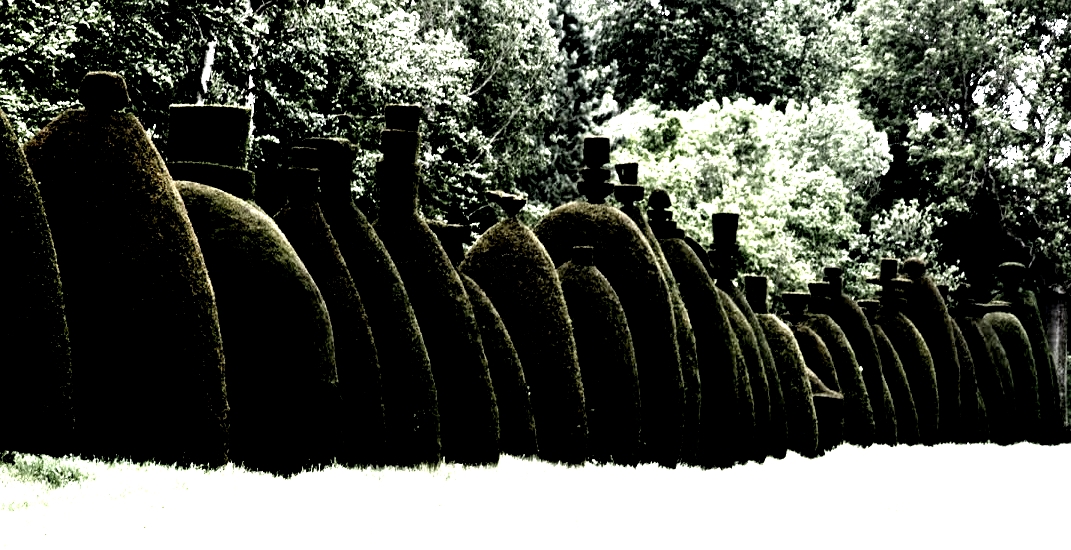
Evergreens, preparing to march.

The last gas canister is nearly used up on the blow-lamp and the Poundland Firelighters have long since expired. And now it’s raining again. I’m pouring some delicatessen grade canola oil on to a pile of smouldering vegetation and I’m wondering how all this began.

I should have been commenting shrewdly on the mental health news, but I’ve had to let things slip. This is the Day of the Hedge, the story that John Wyndham never dared write. I think it began with an innocent attempt to help someone. A number of weeks back a man suddenly turned up and asked if I wanted my hedge trimming. He looked a bit unofficial, but he had a lightweight aluminium bike and a matching petrol hedge trimmer in a duffle bag. It was a cool look, quite unlike the usual tree surgeons, who wear protective gear and drive Land Rover Defenders. I suspected he was new to the war on hedges. I asked him his name, and where he lived. When he told me, I was pretty sure I’d seen that name in the local paper a few times as a person convicted of petty theft and sent to jail. So what? I also remembered that, in mitigation, he was said to have had a drugs problem. So what? We believe in rehabilitation don’t we?

I negotiated him down to £10 and showed him where to put the hedge cuttings. All this passed off smoothly. Before leaving, he glanced at our long line of dissident conifer trees and offered to take them on. Maybe, I thought.

Some weeks later he turned up to do the hedge and we negotiated a price for a full days work. I felt like the man in the vineyard parable. Part of the deal was to come back and take all the cut vegetation away. Again, this all went smoothly. He trimmed the line of trees and made a huge pile of branches. Next day he was going to come and collect them in a trailer.

A few days passed until he turned up again. Could he have an advance of £20 to buy a new tyre for his trailer? OK I thought. At worst I am only going to be £20 poorer, and I still have his ladder, saw and lopper device.

And that, dear reader, was the last I saw of him, some 3 weeks ago. I can’t say I’m not concerned about him, but the pressing problem is the huge pile of branches outside the back door. I have a slight tendency towards pyromania, but let it be said, I have never set fire to anything major, not even an NHS Trust. If I was admitted to a forensic unit, I’m pretty sure I’d be allowed into the smoking area on my own after a month or two. Fire would not figure strongly on my risk assessment.  Nevertheless, there is a tall plume of smoke over my house. I reassure Mrs EP that it is mainly steam and not smoke. I hear the neighbours coughing loudly and I reassure myself they are heavy smokers. My legal advisor tells me there are heavy fines if any nesting birds get made homeless. I prepare a Richard Nixon style deniability defence.

My carbon footprint is growing, but the pile seems as big as ever. For the sixth time, I climb inside the green recycling bin and jump up and down to make just a bit more room for foliage. As I jump, I ponder, and I realise there is a very easy solution.

How many psychiatrists are needed to get rid of a pile of trees? At least four. The first to recognise we are in Denial. The second to find a garden dude in the free local magazine. The third to dial the number. The fourth to mix the martinis. Perhaps an extra one to reassess fire risk.

65. Sleepwalking blindfold, into an amorphous tapestry.

Image

Historians agree that modern times began in 1980, with the invention of Pac-Man.

When did it all go wrong? The answer it seems is 1980. And, to a lesser extent, 1988.

Certainly, quite a few things went wrong in 1980. John Lennon was murdered, the Iran / Iraq war began, Robert Mugabe was installed and worst of all, the post-it note went on sale. In mental health, our particular Chernobyl was an explosion of toxic diagnostic heterogeneity. 1980 saw the invention of the concept ‘major depression’ (MDD). With the publication of the DSM3 diagnostic manual, most emotion-based illnesses was fed into a diagnostic Magimix. This turned out to be very convenient for certain people. One, (sloppy) people who don’t like making diagnoses. Two, the (wicked) inventors and propagators of so-called SSRI antidepressants. Rampant heterogeneity was very inconvenient for anyone who wanted to investigate the possible causes and treatments of Depression. Edward Shorter explains the story much better than I can.*

Certain discrete entities, that should have been studied much more carefully, got lost in the new, amorphous tapestry of MDD. One of these was the notion of ‘biological symptoms’ such as appetite and weight loss, early waking and diurnal mood variation (DMV). The classic ‘melancholic’ patient felt much worse early in the morning. Studies of cortisol and other hormone levels throughout the day showed a changed pattern in most depressed people. Of particular interest was the finding that most depressed patients failed to reduce their cortisol levels even when given a steroid tablet the night before. This led to the ‘dexamethasone suppression test’ and other early attempts to find a definitive lab test for Depression. Old school psychiatrists regarded DMV as a cardinal symptom of melancholia. They separated melancholia from other types of depression with barbed wire, landmines and a no-fly zone.

Today, research into circadian rhythms in organisms and the body clock in humans is a major strand of research in life science. Gene expression studies are the way forward.  And this week, even the BBC acknowledged this by holding a ‘Day of the Body Clock’.

Quite what the editors had in mind for the body clock day remains a mystery. Each news program had to slot in a body clock item but the presenters looked bewildered as to why. We heard that sportsmen performed better in the evenings. Some brave schools are shifting their timetable for teenagers later into the day, when they are more likely to be awake, although the teachers are more likely to be asleep. More interestingly, scientists told us that society was guilty of a ‘supreme arrogance’ in trying to over-ride our need to get enough sleep. Prof Russell Foster, at the University of Oxford, said people were getting between one and two hours less sleep a night than 60 years ago. We were warned that ‘Modern life and 24-hour society mean many people are now “living against” their body clocks with damaging consequences for health and wellbeing’. Further support then for the Blur Theory – Modern Life is Rubbish. Sleep, like lunch and the concept of Melancholia, was abolished in the eighties.

Studies continue to reveal that a sub-group of depressed patients show an abnormal expression of clock genes. Several promising types of non – drug therapy for depression were based on trying to adjust the body clock: Sleep Deprivation, Phase Advance and Bright Light therapy. Unlike SSRI antidpressants, these are treatments that cost hardly anything and can easily be implemented at home. Also unlike SSRIs, these are treatments that no-one ever tries. The post-it note and Robert Mugabe are here to stay, but Shorter is correct to say that MDD must go: ‘melancholia and non-melancholic depression are quite separate illnesses’. I’m having the bumper stickers printed now.

The idea that deliberately reducing sleep can act as an antidepressant seems counter-intuitive. But it’s possible that the insomnia in depression is the body’s attempt to defend itself against low mood. Which means that society as a whole may be trying to stave off existential despair by staying up late.

*Edward Shorter, 2014, The 25th anniversary of the launch of prozac gives pause for thought: where did we go wrong? BJPsych, 204, 331-2.